XIAMEN ACEY NEW ENERGY TECHNOLOGY CO., LTD.
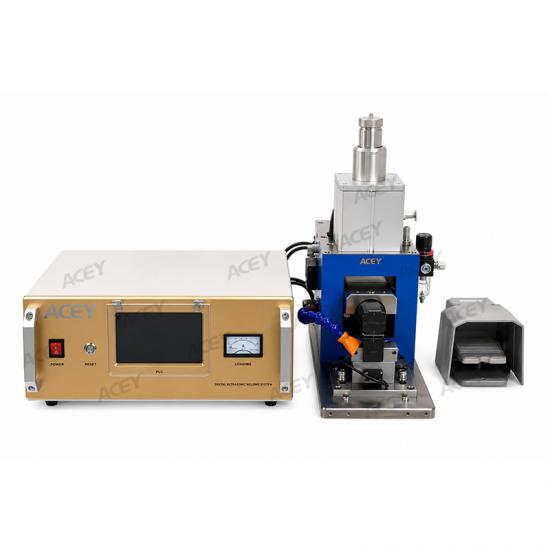
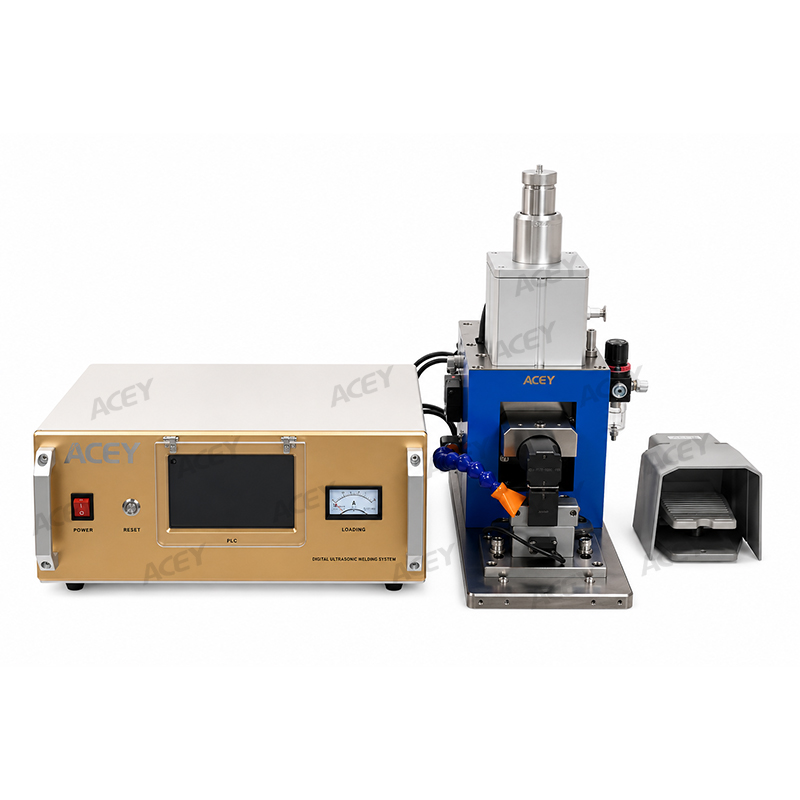
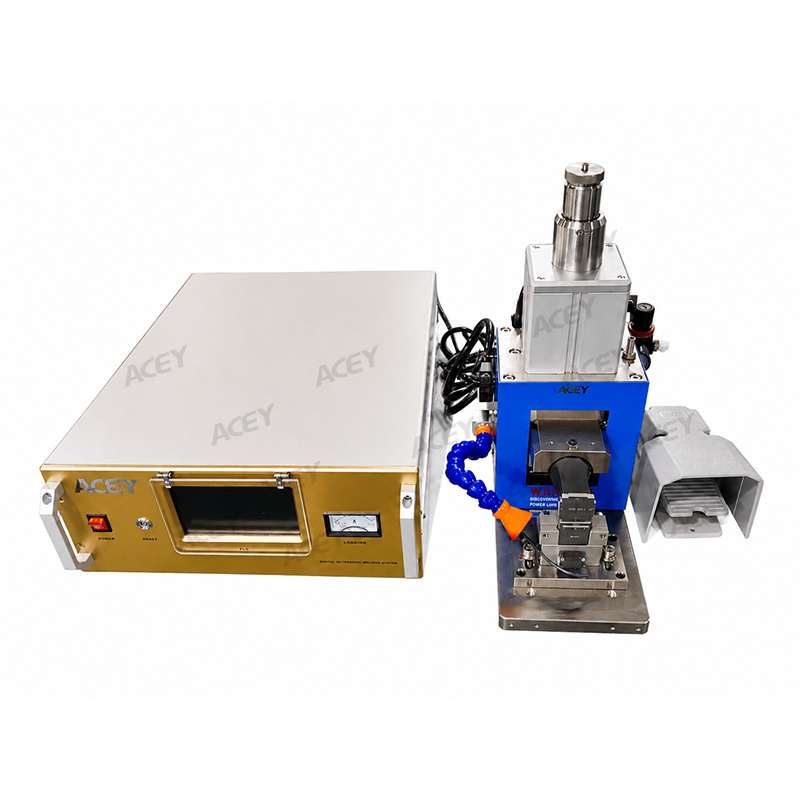
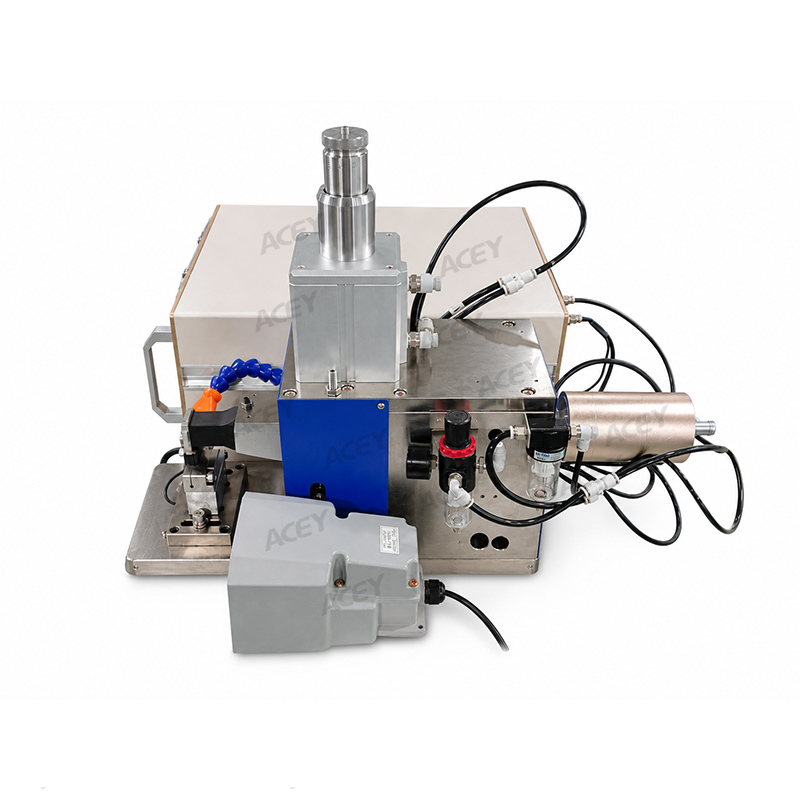
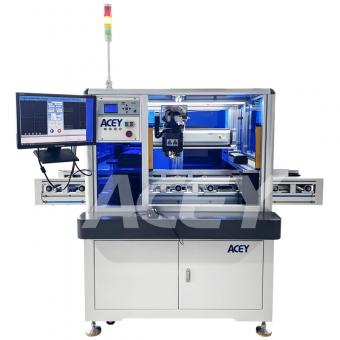
ACEY-UWM-20-6000 Ultrasonic Metal Welding Machine is designed for welding aluminum battery tabs to nickel-plated copper terminals, providing strong, low-resistance connections for pouch cell, battery module and PACK assembly.
Brand:
ACEYItem No.:
ACEY-UWM-20-6000Compliance:
CE CertifiedWarranty:
One-year warranty with lifetime supportOrder(Moq):
1 setPayment:
T/TProduct Origin:
ChinaLead Time:
7-35 days6000W Desktop Ultrasonic Metal Welder For Aluminum-to-Nickel Battery Tab Welding
Product Description
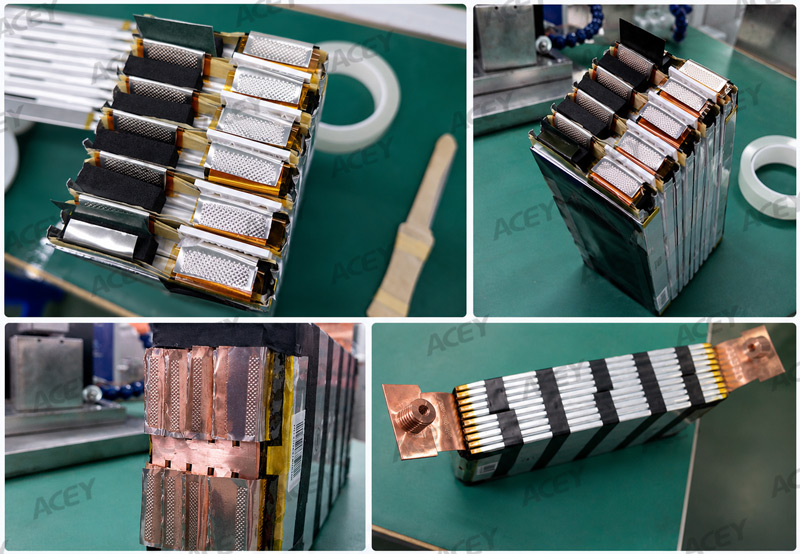
ACEY-UWM-20-6000 Ultrasonic Metal Welder is designed for aluminum-to-nickel-plated copper welding in pouch cell and battery PACK assembly. It is suitable for connecting aluminum battery tabs to nickel-plated copper terminals, providing a stable weld with low electrical resistance and a clean, flat welding surface.
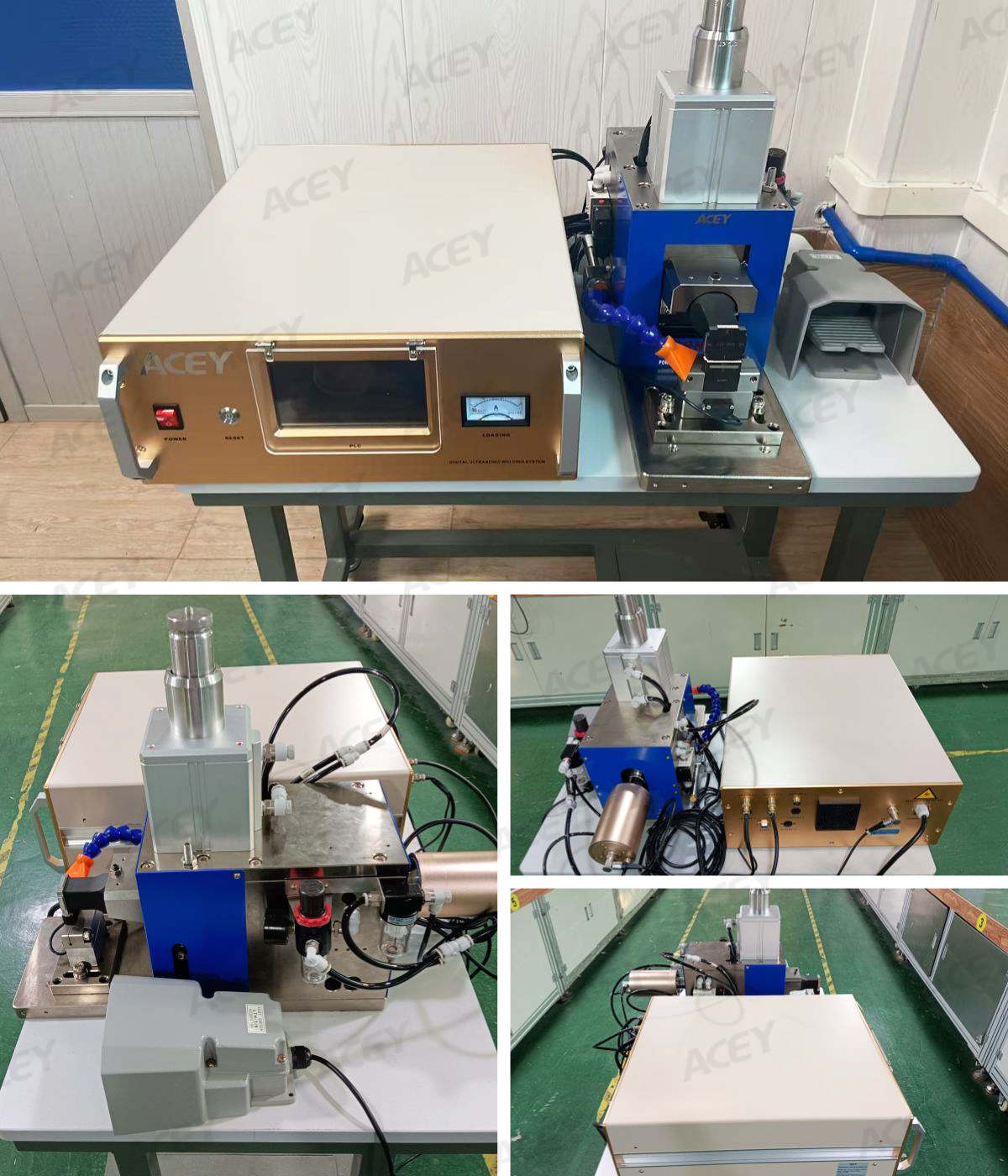
Equipped with a digital intelligent ultrasonic generator, a high-rigidity steel welding head and specially designed upper and lower welding tools, the machine supports time, energy and segmented welding modes. It can be operated manually by foot pedal or integrated into an automated battery assembly line through I/O signal control.
Main Applications
ACEY-UWM-20-6000 ultrasonic metal welding machine is suitable for:
Product Features
1. Digital Intelligent Ultrasonic Generator
The full-digital full-bridge circuit provides stable output and strong welding capability. It includes energy feedback, automatic frequency tracking and an RS-485 communication interface for process monitoring and production-line integration.
2. Multiple Welding Modes
The machine supports time mode, energy mode and segmented welding mode. Welding parameters can be stored and recalled, making it easier to switch between different battery products and welding processes.
3. Welding Curve Monitoring
Voltage, current and power curves can be displayed and compared to help operators monitor welding performance, evaluate process stability and optimize welding parameters.
4. High-Rigidity Welding Head
The welding head uses a precision guide-column steel structure with good resistance to torsion. This design supports fast and stable vertical movement while maintaining consistent welding pressure and positioning.
5. Adjustable Welding Parameters
Ultrasonic amplitude can be adjusted from 10% to 100%, while the welding pressure can be set from 0.1 to 0.6 MPa. The typical welding time is between 0.1 and 0.8 seconds, with a programmable range of 0 to 60 seconds.
6. Durable Customized Welding Tools
The upper and lower welding tools are made from selected high-speed steel and processed using professional heat-treatment technology. Their surface patterns can be customized according to the material, thickness, tab width and required welding area.
7. Integrated Cooling and Safety Protection
An integrated cooling system supports stable operation during repeated welding cycles. Photoelectric detection is also included to provide additional protection around the welding area.
8. Reliable Welding Results
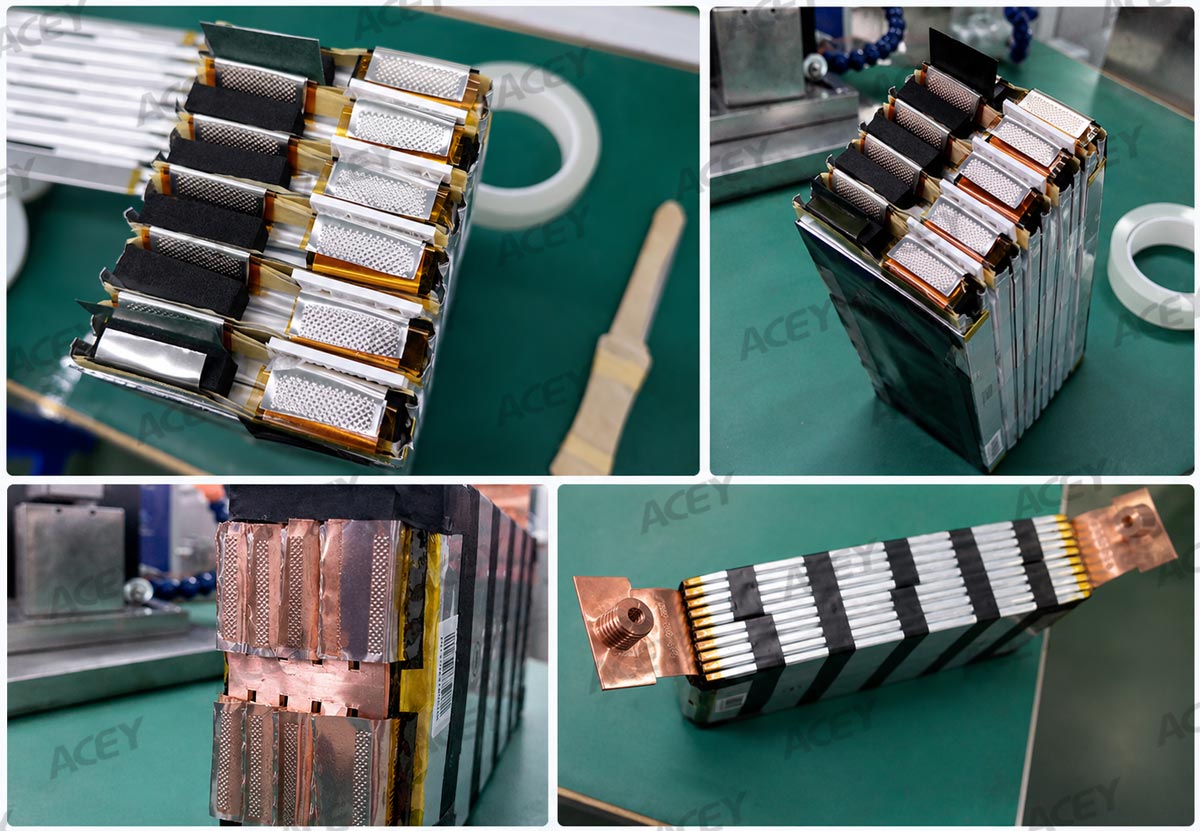
Under suitable material and process conditions, the machine produces firm, low-resistance joints with clear welding patterns and flat surfaces. It is designed to reduce false welding, missed welding, weld-through, powder generation, tab cracking and damage to the separator or insulating adhesive.
9. Flexible Standalone or In-Line Operation
The manual configuration is controlled by a foot switch, while the production-line version can be controlled through I/O signals. Its split structure also simplifies transportation, installation and maintenance.
10. Designed for Battery Tab Welding
The machine is primarily intended for welding pure aluminum sheet to nickel-plated copper sheet in pouch cell, battery module and high-capacity battery PACK production.
Supported Welding Process
The standard process described in the specification is intended for connecting:
| Material | Standard Thickness |
| Pure aluminum sheet | 0.30 ± 0.05 mm |
| Nickel-plated copper sheet | 0.20 ± 0.05 mm |
The equipment is designed for single-layer transition welding. Typical welding sizes include:
| Welding Size | Reference Tab Width |
| 20 × 3 mm | Approximately 25 mm |
| 10 × 4 mm | Approximately 14 mm |
| Maximum compatible weld area | Approximately 25 × 4 mm |
| Maximum compatible tab width | Approximately 30 mm |
The number of cells connected in series or parallel is not specifically limited. Compatibility mainly depends on the material combination, tab dimensions, weld-area design and production-line layout.
Technical Specifications
| Item | Specification |
| Product name | Ultrasonic Metal Welding Machine |
| Model | ACEY-UWM-20-6000 |
| Main application | Aluminum-to-nickel-plated copper welding |
| Maximum input power | 6000 VA |
| Ultrasonic frequency | 20 kHz ± 200 Hz |
| Frequency control | Automatic frequency tracking |
| Welding modes | Time mode, energy mode and segmented mode |
| Typical welding time | 0.1–0.8 seconds |
| Programmable time range | 0–60 seconds |
| Welding pressure | 0.1–0.6 MPa |
| Amplitude adjustment | 10–100% |
| Manual welding-head stroke | 10–15 mm |
| Automated-line stroke | 25–45 mm |
| Manual control method | Foot switch |
| Production-line control | I/O signal |
| Communication interface | RS-485 |
| Driving method | Pneumatic |
| Power supply | Single-phase AC 220 V ±10%, 50 Hz |
| Recommended socket | 16 A |
| Recommended power cable | 3 mm² |
| Air pressure | 0.6 MPa |
| Air requirement | Dry and clean compressed air |
| Air-tube interface | 8 mm diameter |
| Air consumption | Approximately 0.6 m³/h |
| Operating humidity | Below 48% |
| Maximum operating temperature | 45°C |
| Structure | Split, all-metal construction |
Product Display
Welding Effect Display
Machine Configuration
The ultrasonic welding system mainly consists of:
Welding Tool Service Life
| Welding Application | Reference Service Life |
| Aluminum-to-nickel-plated copper welding | More than 50,000 cycles per tool |
| Nickel-to-nickel welding | Approximately 20,000 cycles per tool |
The upper and lower welding tools are consumable components. Actual tool life may vary according to the welded material, thickness, surface condition, welding pressure, amplitude, operating frequency and maintenance condition.
Operation and Line Integration
The standalone machine is controlled by a foot switch. Its standard manual welding-head stroke is approximately 10–15 mm.
For production-line integration, the welding cycle can be controlled through I/O signals. The welding-head stroke can be designed between 25 and 45 mm according to the production-line layout and product requirements.
Quality Inspection and Acceptance
The welded joint can be torn apart to inspect the remaining bonded area and confirm penetration between the metal layers.
For a reference welding size of 25 × 3 mm, the destructive tensile force should be greater than 80 N.
Maintenance Recommendations
The upper and lower welding tools should be checked regularly for wear, surface contamination and material adhesion. Production should not continue with severely worn or contaminated welding surfaces.
To maintain stable welding quality:
FAQ
1. What is the ACEY-UWM-20-6000 used for?
It is mainly used for ultrasonic welding of aluminum battery tabs to nickel-plated copper terminals in pouch cell, battery module and battery PACK production.
2. What materials can this ultrasonic welding machine weld?
The standard process is designed for welding 0.30 ± 0.05 mm pure aluminum sheet to 0.20 ± 0.05 mm nickel-plated copper sheet.
3. What welding modes are available?
The machine supports time mode, energy mode and segmented welding mode. Welding parameters can be stored and recalled for repeated production.
4. Can the machine be integrated into an automatic production line?
Yes. The automated-line version can receive I/O control signals, and the RS-485 interface supports communication and process-data integration.
5. What power supply is required?
The machine requires single-phase AC 220 V ±10%, 50 Hz power, a 16 A socket and reliable grounding.
6. What compressed-air supply is required?
Dry and clean compressed air at approximately 0.6 MPa is required. The standard air-tube connection has a diameter of 8 mm.
7. Can welding pressure and amplitude be adjusted?
Yes. Welding pressure can be adjusted from 0.1 to 0.6 MPa, while ultrasonic amplitude can be set from 10% to 100%.
8. Can the welding tools be customized?
Yes. The welding-tool pattern and dimensions can be designed according to the tab material, thickness, width, welding area and available installation space.
9. How is welding quality inspected?
The welded joint can be evaluated through a tear-and-residual-bond test or a tensile-force test. For a reference weld size of 25 × 3 mm, the specified tensile force is greater than 80 N.
10. How long do the welding tools last?
For aluminum-to-nickel-plated copper welding, the reference service life is more than 50,000 cycles per tool. Actual service life depends on the material, process parameters and maintenance condition.
11. What is the difference between the manual and in-line versions?
The manual version uses foot-switch control and has a standard head stroke of 10–15 mm. The in-line version uses I/O control and can have a stroke of 25–45 mm depending on the production-line design.
12. What maintenance is required?
Daily trial welding and regular inspection of the welding tools are recommended. The cooling system, pneumatic components, material consistency and welding parameters should also be checked regularly.
 200W Automatic Laser Spot Welding Machine For Laptop Polymer Lithium Battery
ACEY-LTW-200W battery laser welding machine is used for series parallel electrode tab welding of polymer and cylindrical batteries.
 200W Power Bank Polymer Battery Pack Automatic Laser Spot Welder
ACEY-MLW-200T automatic polymer battery tab laser spot welding machine is used for welding the tabs of power bank batteries.
 Automatic Pouch Cell Tab Laser Spot Welding Machine For Smart Lock Battery
ACEY-SLW-200-4T laser spot welding machine is designed for smart lock polymer lithium battery packs. It uses laser welding technology to achieve fast and reliable connection between battery tabs, nickel sheets and PCB boards.
 Automatic Smart Lock Polymer Battery Pack Laser Spot Welding Machine
ACEY-SLW-200-6T battery pack laser spot welder is mainly used for automatic welding of polymer battery pack PCB boards and battery tabs in series and parallel connections in mobile phones, tablets, laptops, smart locks, etc.
 200W Automatic Polymer Lithium Battery Laser Spot Welder For Mobile Phone Battery
ACEY-MPW-200W automatic laser spot welder is applied to the tab welding of polymer batteries such as mobile phones and power banks.
 5V 40A 128 Channels Polymer Pouch Lithium Cell Testing Machine
ACEY-PCT540-128 pouch lithium cell testing machine is used to test the voltage, capacity and other parameters of polymer batteries, and classify the battery capacity according to the test results.
 7-Channel Automatic Battery Sorter Polymer Lithium Cell Voltage IR Sorting Machine
ACEY-PCSM polymer lithium battery sorting machine is a device used to automatically sort battery voltage and internal resistance of polymer lithium batteries in the fields of power batteries, 3C digital batteries, and energy storage batteries.
 Cell Phone Battery PCB Spot Laser Welding Machine For Polymer Lithium Battery
ACEY-MPW-200S spot laser welding machine is used for welding the tabs of mobile phone batteries and PCB boards.
Rm703, No.223, Qishan North Road, Huli District, Xiamen, Fujian, China
Email : allen@xmacey.com
Tel : +8618950009155
Whatsapp : +8618950009155