XIAMEN ACEY NEW ENERGY TECHNOLOGY CO., LTD.
![$this->product_detail['product_name']](/uploadfile/category/c27981019656b6e070d89f246e17014d.jpg)
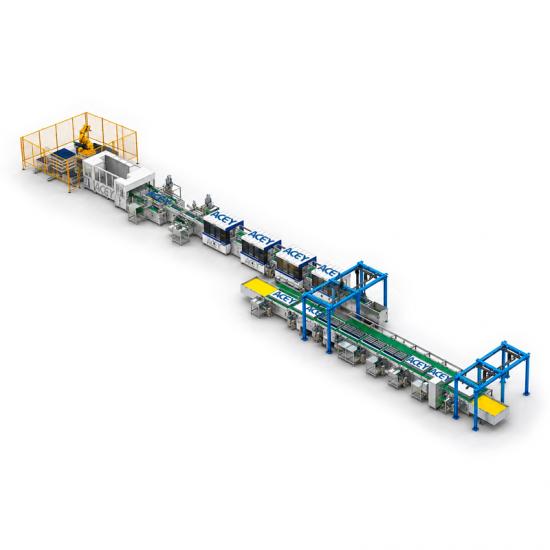
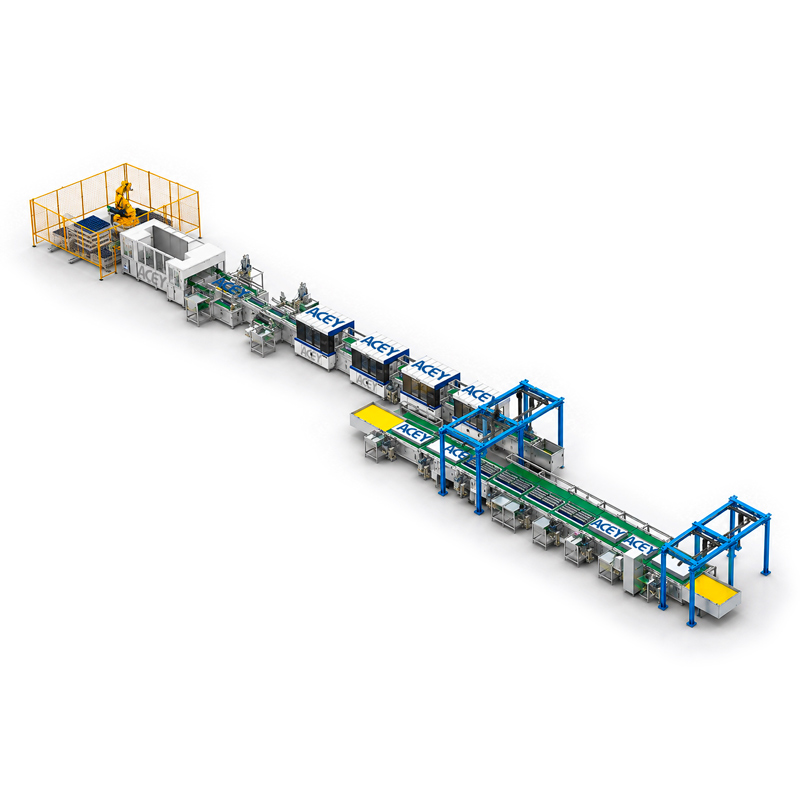
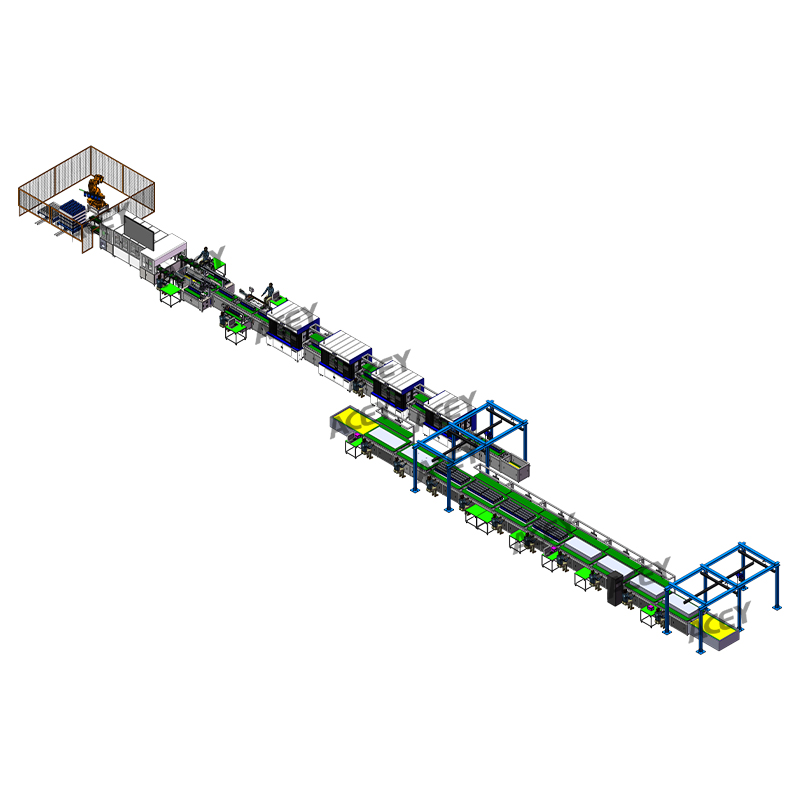
ACEY-APAL-ESS Automatic Energy Storage Battery Pack Production Line is designed for efficient production of prismatic lithium battery modules and energy storage packs. The assembly line integrates cell sorting, stacking, compression, laser welding, EOL testing, PACK assembly, and MES traceability. It supports 100–314Ah prismatic cells, liquid-cooled and air-cooled designs, with customizable layouts and automation levels.
Brand:
ACEYItem No.:
ACEY-APAL-ESSCompliance:
CE CertifiedWarranty:
One-year warranty with lifetime supportOrder(Moq):
1Payment:
T/TProduct Origin:
ChinaAutomatic Energy Storage Battery Module and PACK Assembly Line
Product Overview
ACEY-APAL-ESS Automatic Energy Storage Battery Pack Production Line is designed for the production of prismatic lithium battery modules and energy storage battery packs. The complete line combines automated cell handling, OCV testing, sorting, stacking, compression, laser cleaning, laser welding, module testing, PACK assembly, EOL testing, and traceability management.
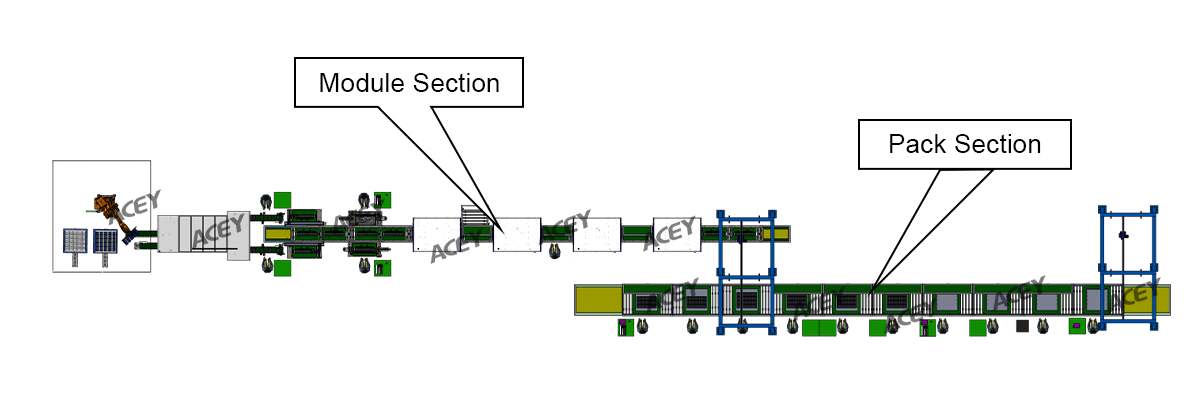
The production line consists of two main sections: the battery module assembly line and the battery pack assembly line. It can be configured for both liquid-cooled and air-cooled energy storage battery designs and adapted to different cell sizes, module structures, production capacities, and automation requirements.
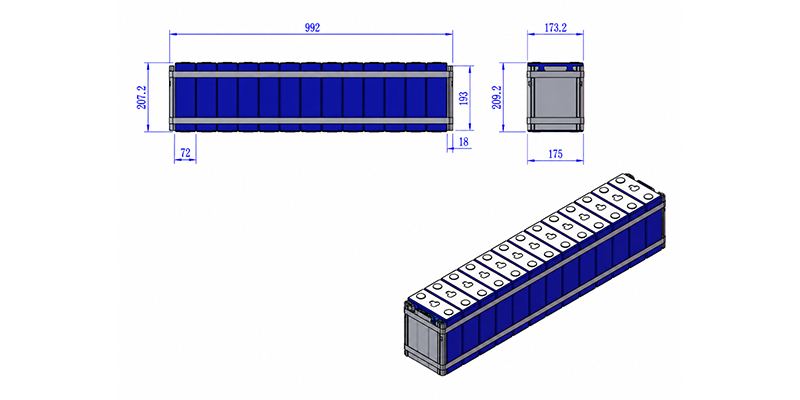
The reference configuration is based on a liquid-cooled 1P13S module using prismatic cells, while tooling and fixtures can be adjusted for other module formats.
| Cell Specifications | Product Specifications | Series/Parallels | Dimensions | Weight / Kg | ||
| L/mm | W/mm | H/mm | ||||
| 280/314 | Single Module | 1P8S | 590 | 182 | 218 | 51 |
| Single Module | 1P12S | 905 | 182 | 218 | 69.5 | |
| Single Module | 1P13S | 977 | 182 | 218 | 78 | |
Applications
This energy storage battery production line is suitable for:
Main Features
Full-Line Process Flowchart
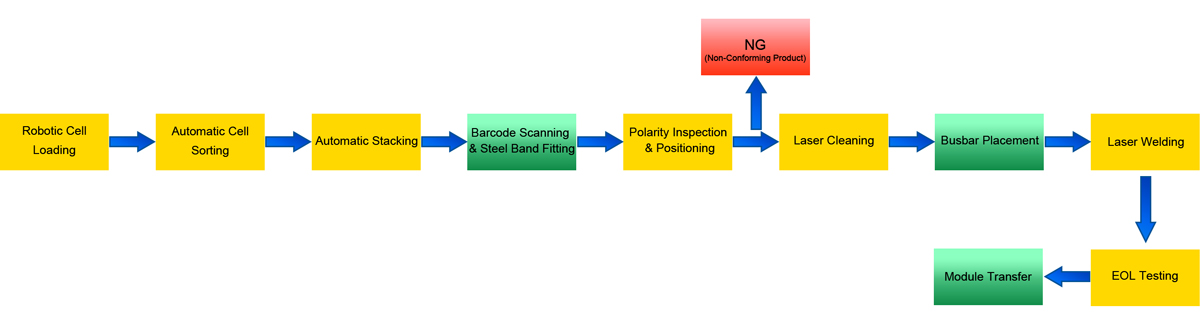
*Battery Module Assembly Process
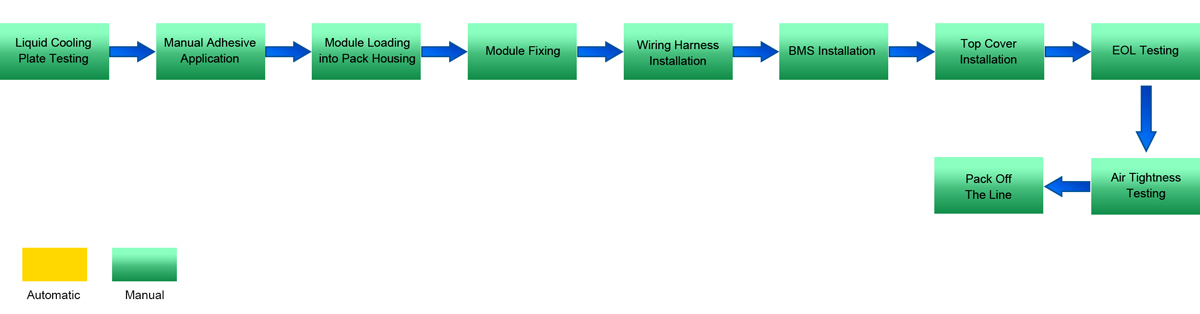
*Battery Pack Assembly Process
Whole Line Layout
*2D Layout
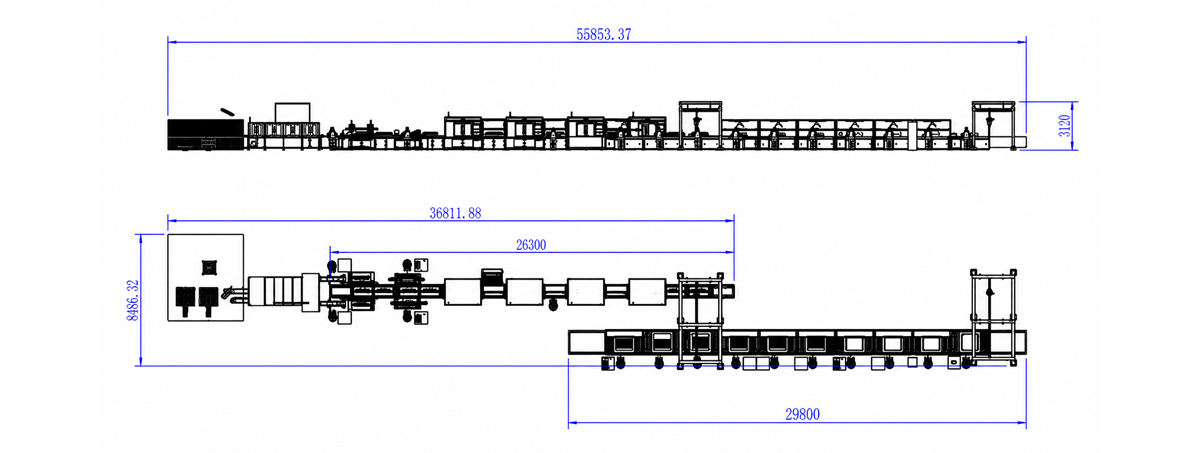
*Full-Line Size Diagram
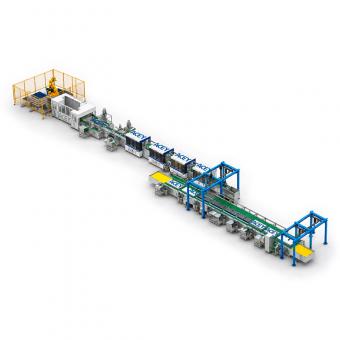
Overall size of the line: 56x8.5x3.5m(L*W*H m) (the final size is subject to the actual design).
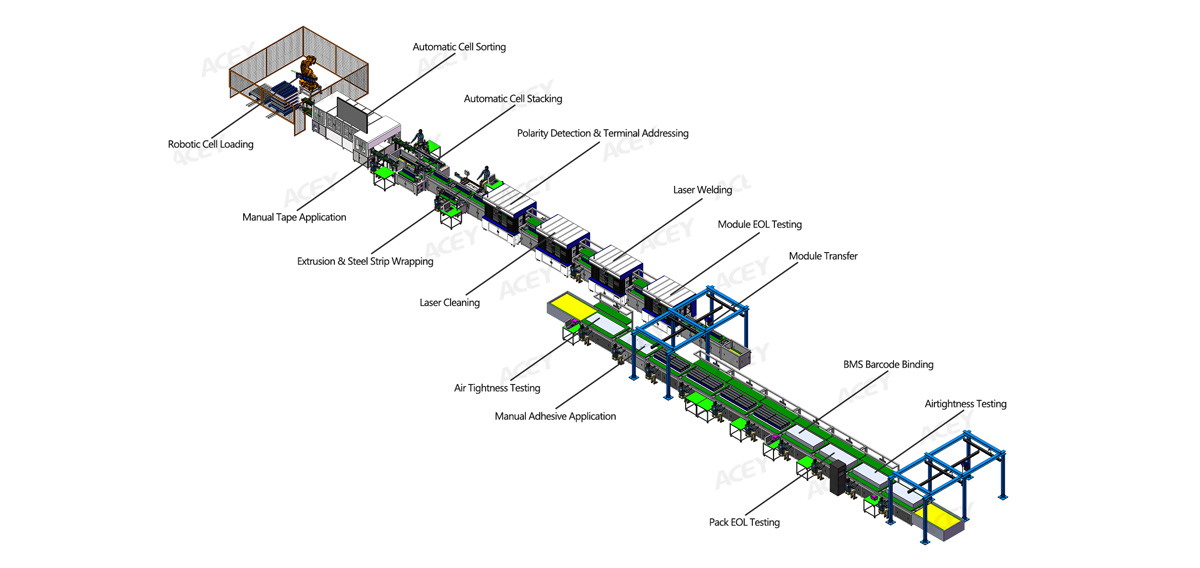
The whole line is divided into: cell processing section, module stacking section, module pre/welding/after processing section, PACK box on-line processing section, module into box assembly section, PACK finished product testing and offline section.
*3D Layout
Battery Module Assembly Line
1. Robotic Cell Loading
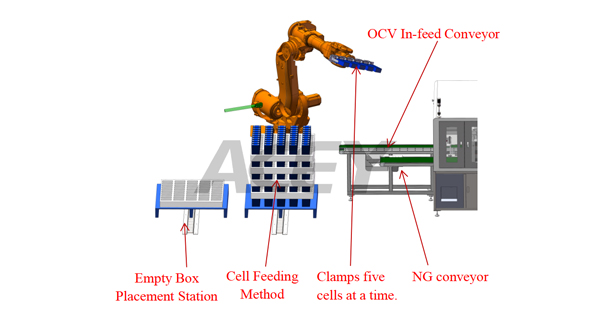
Prismatic cells are supplied in foam trays or boxes and manually transferred to the loading area. A robot equipped with a vision system identifies the cell position, grips the cells, and places them onto the OCV infeed conveyor.
After all cells have been removed, the robot transfers the empty box to the designated empty-box placement station. Safety fencing is installed around the robotic loading area.
Main functions
2. Battery OCV Sorting
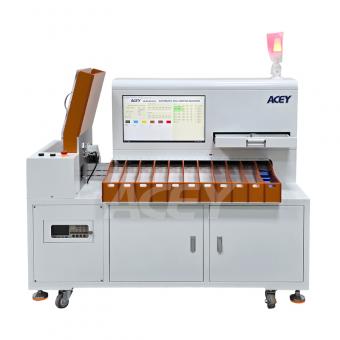
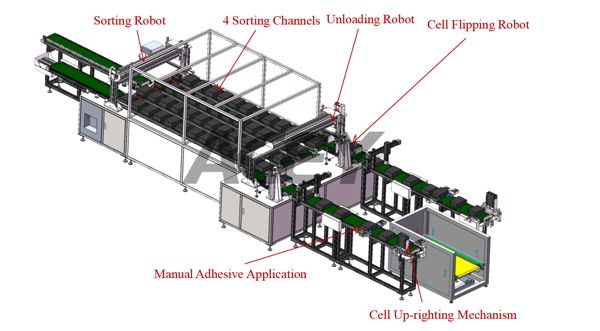
Each cell is automatically scanned before testing. The system measures open-circuit voltage and internal resistance and can calculate the K value according to the configured process requirements.Each cell is automatically scanned and tested for open-circuit voltage and internal resistance. The system calculates the K value, sorts qualified cells into four channels according to the module recipe, and transfers non-conforming cells to the NG conveyor or rework station.
After sorting, the cells are automatically flipped when required and transferred to the processing conveyor. A servo-driven plasma cleaning head cleans the cell insulation film before adhesive or insulating pads are manually applied. The finished cells are then positioned upright by an automatic mechanism and transferred to the module stacking station.
The cells are divided into four sorting channels according to the test results and module recipe. Non-conforming cells are automatically transferred to the NG conveyor or rework cart.
Main functions
4. Automatic Module Stacking
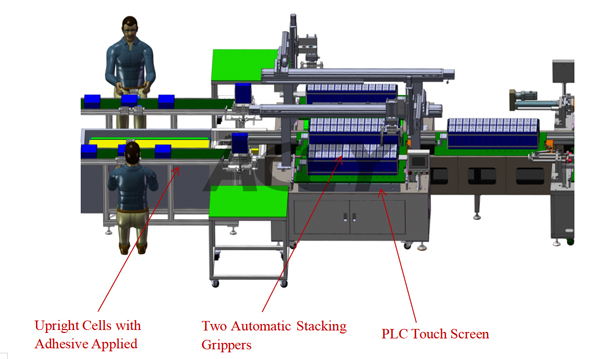
The automatic stacking system arranges the prepared cells according to the selected series and parallel configuration.
The operator can set the required module recipe through the PLC touchscreen. The stacking grippers transfer the upright cells to the stacking fixture and complete the module arrangement automatically.
Main functions
5. Module Compression and Steel Band Fitting
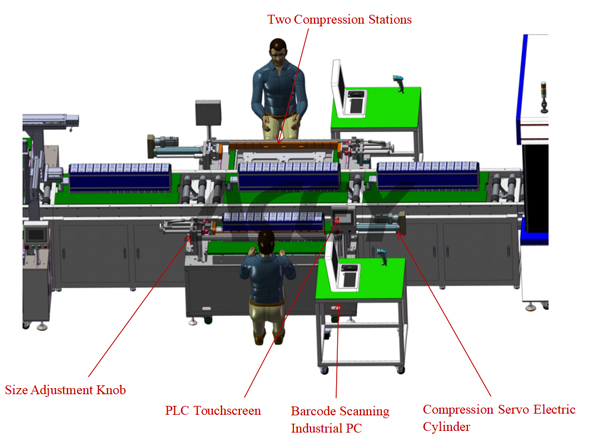
After stacking, the module is transferred to the compression station. The servo electric cylinder applies controlled pressure through the module end plates.
The compression force and travel can be adjusted according to the module dimensions. After compression, the module can be secured with steel bands or plastic-steel straps.
All cell codes can be scanned and linked to a newly generated module barcode for production traceability.
Main functions
6. Polarity Inspection and Terminal Positioning
A CCD vision system scans the module barcode and inspects the position and polarity of each cell terminal.
The inspection coordinates are stored and transferred to the subsequent laser cleaning and laser welding stations. Modules that fail inspection are automatically transferred to the NG workstation with an audible and visual alarm.
Main functions
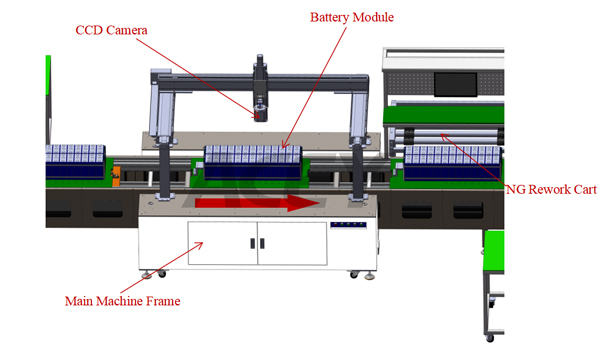
7. Laser Cleaning
The laser cleaning station removes oxide layers, dust, and surface contamination from the cell terminals before welding.
The system reads the module code and retrieves the corresponding terminal coordinates. A CCD camera, laser distance sensor, and three-axis gantry guide the laser cleaning head to each terminal. After cleaning completed, mechanism resets, pallet flows to next process;
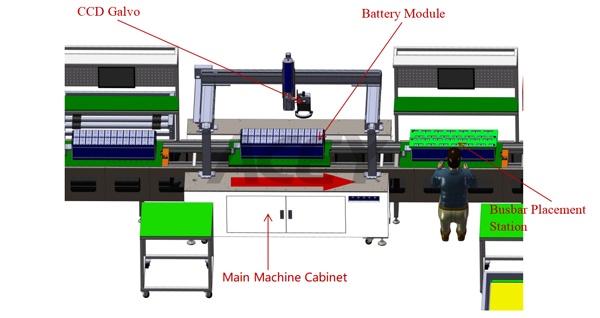
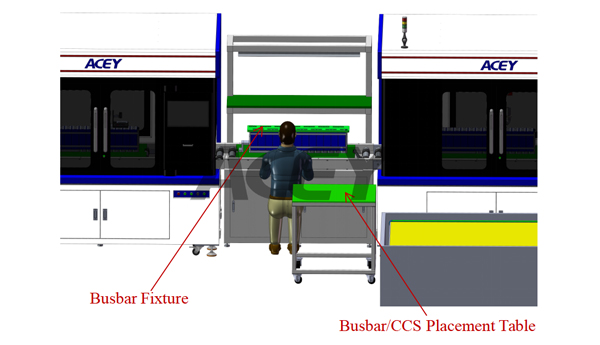
8. Busbar and CCS Placement
The module is transferred to the manual busbar placement station. The operator installs the positioning fixture and places the busbars, positive and negative terminal blocks, or CCS assembly according to the selected module recipe. After placement, the module is released to the laser welding station.
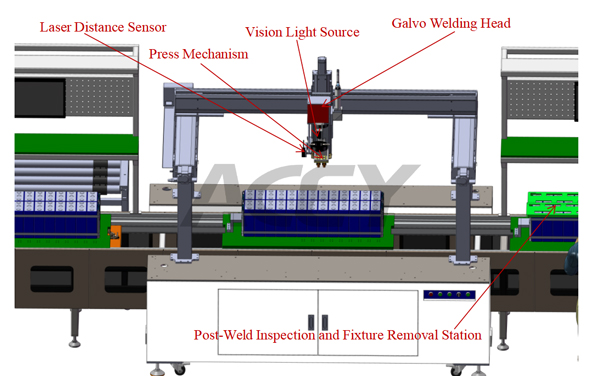
9. Laser Welding
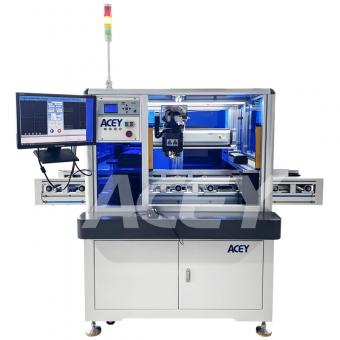
The automatic laser welding station connects the busbars to the cell terminals. The system scans the module code, retrieves the positioning coordinates, identifies the reference points, adjusts the focal distance, clamps the busbars, and completes the welding process automatically.
Main functions
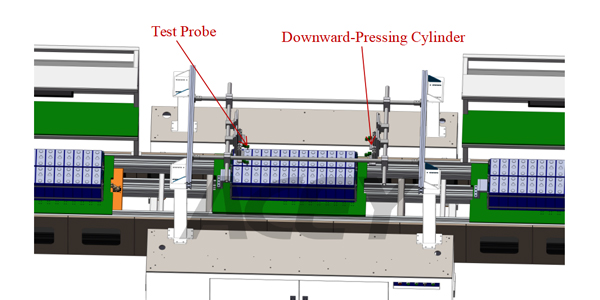
11. Module EOL Testing
The module EOL station uses independently adjustable probes to contact the module terminals and end-plate positions.
Available test items:
12. Module Transfer
Qualified modules are transferred from the module line to the PACK assembly section using a gantry lifting system.
The reference lifting system provides a maximum load capacity of 500 kg and includes protection against power loss, accidental operation, and hook disengagement.
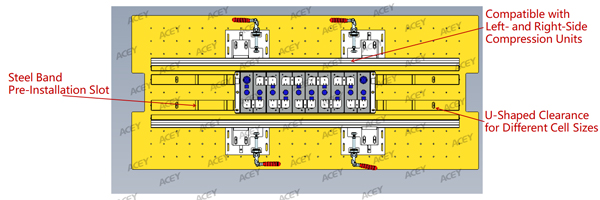
Module Tooling Pallet
The tooling pallet consists of a 15 mm aluminum base plate and a 5 mm Bakelite insulating surface layer, with overall dimensions of 1,200 × 600 × 20 mm.
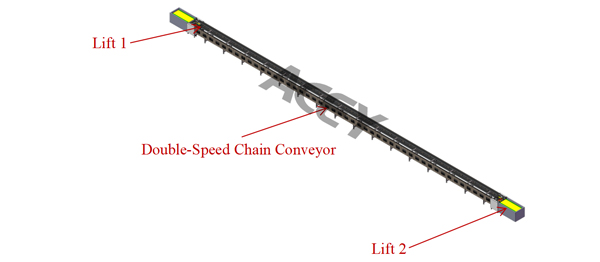
Module Conveyor System
A continuous double-speed chain conveyor transfers modules between workstations. Lifts installed at both ends enable automatic tooling pallet return and closed-loop circulation.
Battery Pack Assembly Line
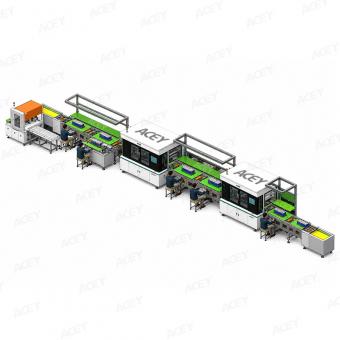
The PACK section uses modular chain-driven roller conveyors and can be divided into three areas:
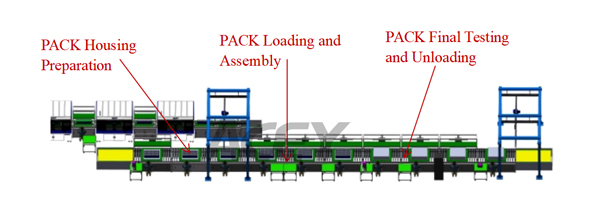
1. PACK Housing Preparation
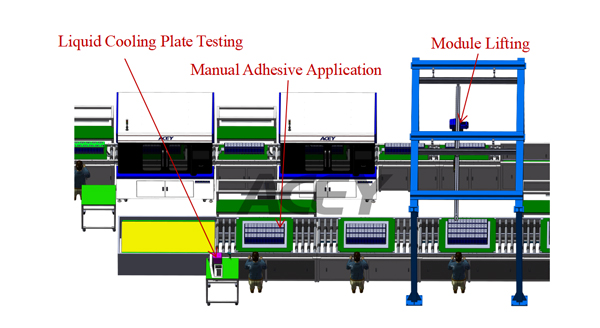
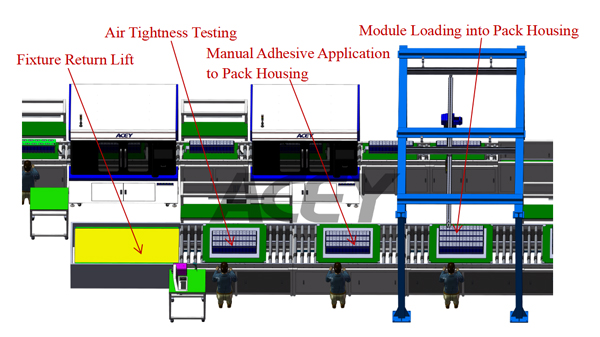
The liquid cooling plate or PACK housing is manually loaded onto the production line and tested for air tightness. After the test, the system generates a PACK barcode and uploads the result to the MES traceability system.
The housing is then positioned at the adhesive application station, where the operator applies adhesive according to the production recipe. After adhesive application, battery modules are lifted from the module line and placed into the PACK housing using a gantry lifting system.
Main Processes:
Liquid Cooling Plate Testing → PACK Barcode Generation → Manual Adhesive Application → Module Loading into PACK Housing
2. Module Loading and PACK Assembly
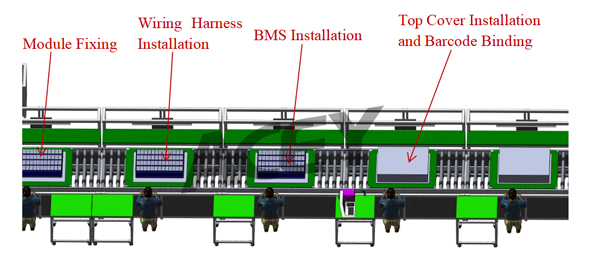
After the modules are loaded into the housing, operators complete module fixing, wiring harness installation, BMS installation, and top cover installation.
At the BMS installation station, the module and BMS barcodes are scanned and linked. The system then integrates the module and BMS information into the PACK barcode and uploads the data to the MES system for production traceability.
Main Processes:
Module Fixing → Wiring Harness Installation → BMS Installation and Barcode Binding → Wiring Arrangement → Top Cover Installation
3. Final Testing and Unloading
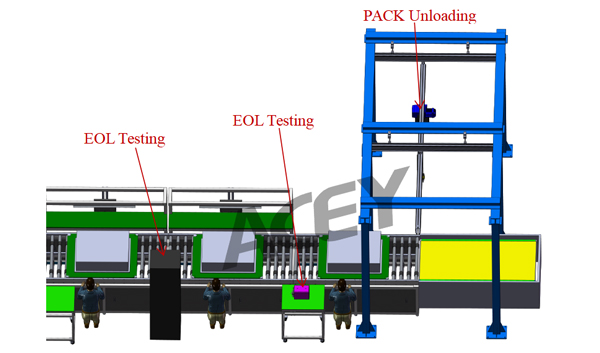
The assembled PACK is transferred to the final testing section. The PACK EOL station can test insulation resistance, dielectric withstand voltage, BMS communication, no-load voltage, AC internal resistance, and temperature monitoring.
After EOL testing, the complete PACK undergoes an air-tightness test. All test results are linked to the PACK barcode and uploaded to the MES system. Qualified products are then removed from the line using a gantry lifting system.
Main Processes:
PACK EOL Testing → Air Tightness Testing → Test Data Upload → PACK Unloading
PACK Conveyor System
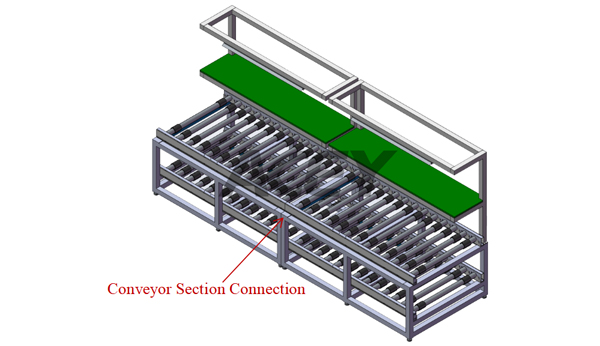
The PACK assembly line uses a chain-driven roller conveyor with an upper-and-lower tooling return structure. The line is manufactured in modular sections, with each section approximately 2.5 meters long and equipped with lighting, stoppers, and operation switches.
Main Technical Parameters
| Item | Reference Specification |
| Production line type | Automated module line with configurable manual PACK assembly stations |
| Compatible cell type | Prismatic aluminum-shell lithium cells |
| Reference cell capacity | Approximately 100–314 Ah |
| Cooling structure | Liquid-cooled and air-cooled PACKs |
| Reference module formats | 1P8S, 1P12S, 1P13S and selected 1P16S designs |
| Reference production capacity | 8 cells per minute |
| First-pass yield | ≥98% |
| Final yield after rework | ≥99.5% |
| Single-machine availability | ≥98% |
| Single-machine failure rate | ≤2% |
| Product changeover time | ≤4 hours |
| Module compression force | 10–1,500 kgf adjustable |
| Laser cleaning power | Reference 200 W MOPA |
| Laser welding power | Up to 6,000 W |
| Module transfer capacity | Reference 500 kg |
| PACK unloading capacity | Up to 1 ton |
| MES connection | Available |
| Reference line dimensions | Approx. 56,000 × 8,500 × 3,500 mm |
| Control system | PLC, industrial computer and MES interface |
| Conveyor type | Belt, roller and double-speed chain conveyors |
Production capacity is calculated based on the reference 1P13S liquid-cooled module and excludes manual loading and unloading time. Final parameters are determined by the approved product drawings and line configuration.
MES and Production Traceability
All major machines can be connected to the MES system for centralized production data collection and traceability.
MES communication protocols and a compatible server environment are required for system integration. Depending on the project scope, the system can record:
Factory Installation Requirements
| Item | Requirement |
| Power supply | Three-phase five-wire, 380 V ±10%, 50 Hz |
| Reference total power | Approximately 100 kW |
| Compressed air | 0.5–0.8 MPa |
| Nitrogen, when required | 0.4–0.6 MPa, purity 99.99% |
| Floor load capacity | At least 650 kg/m² |
| Operating temperature | 15–35°C |
| Relative humidity | 40–85% RH |
| Installation environment | No severe vibration, excessive dust, corrosive gas, or explosive gas |
FAQ
*What battery cells can the production line handle?
The reference line is designed for prismatic aluminum-shell lithium cells from approximately 100Ah to 314Ah. Other cell dimensions can be supported through customized fixtures and handling mechanisms.
*Is the line fully automatic?
The module section includes automated loading, sorting, stacking, inspection, cleaning, welding, and testing. Several assembly processes, particularly in the PACK section, are completed manually or semi-automatically. The automation level can be increased according to the project requirements.
*Can the line produce both liquid-cooled and air-cooled battery packs?
Yes. The line can be configured for both liquid-cooled and air-cooled energy storage battery designs.
*Does the line support MES integration?
Yes. Cell, module, BMS, welding, testing, and PACK production data can be uploaded to the customer’s MES system. The customer must provide the communication protocol and server interface.
*Can the module size be customized?
Yes. The stacking, compression, conveying, lifting, inspection, and welding fixtures can be customized according to the module dimensions and series-parallel configuration.
*What tests are included?
The line can include OCV and internal resistance testing, polarity inspection, module voltage testing, insulation resistance testing, dielectric withstand testing, BMS communication testing, PACK EOL testing, and air-tightness testing.
*How long does product changeover take?
The reference changeover time is within four hours. Actual time depends on the differences between product models and the number of fixtures or parameters that must be changed.
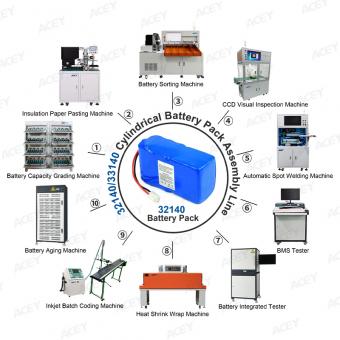
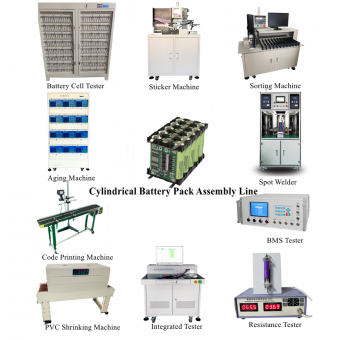 Lithium Ion Battery Manufacturing Machines Cylindrical Battery Pack Line
Acey New Energy can offers the whole cylindrical battery pack assemble equipments for battery laboratory research and manufacturing.
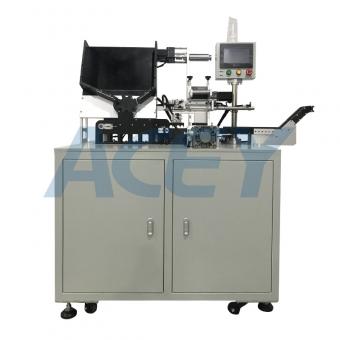 Automatic Lithium Ion Battery Insulation Paper Sticking Machine For Cylindrical Cell
ACEY-BS01 is an automatic equipment for pasting barley paper on cylindrical batteries.
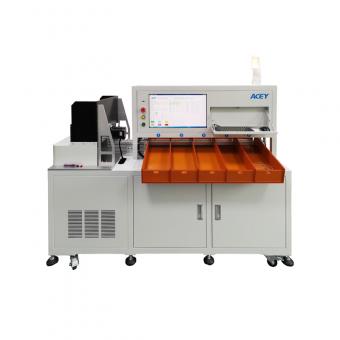
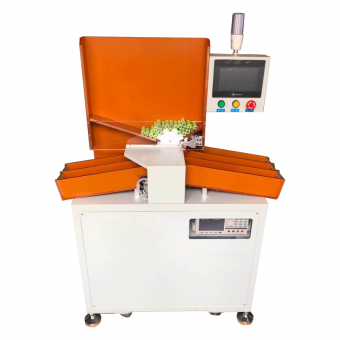 Automatic 5 Channel Cylinder Batteries Sorting Machine For 18650 Battery Pack Line
ACEY-AS5S can automatically sort the batteries according to the specified requirements, and has the characteristics of rapid and accurate sorting.
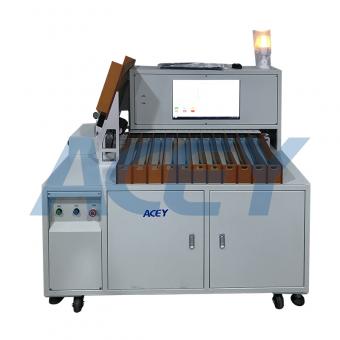 11 Channel 18650-32700 Lithium Battery Cell Sorting Machine For Cylindrical Cell
ACEY-AS11S Battery sorter can automatically sort the batteries according to the specified requirements, and has the characteristics of rapid and accurate sorting. Auto sorting machine fundamentally avoids unreliable factors such as human misoperation and misclassification in the battery sorting process, and improves the quality and efficiency of battery sorting.
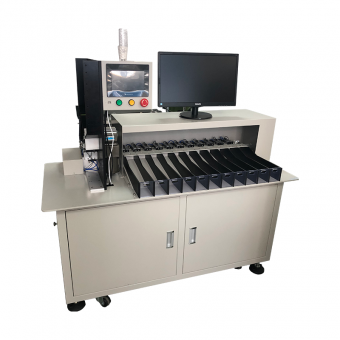 11 Channel Battery Sorting Machine For Battery Internal Resistance and VoltageTesting
This 18650 battery automatic sorting machine is used for cylindrical battery pack assembly line.
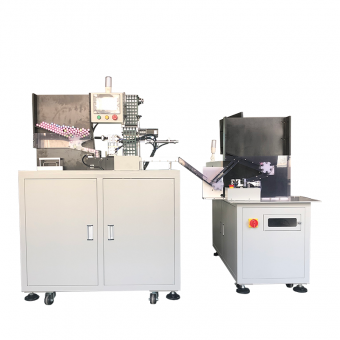 Multifunction 2 In 1 Insulation Paper Sticker And Sorting Machines For Battery Pack Assembly
The cylindrical 18650 battery automatic sticker sorting machine is a test sorting device for checking the internal resistance and voltage of the cylindrical battery after the surface mat, and comes with a high-precision internal resistance and voltage automatic test system.
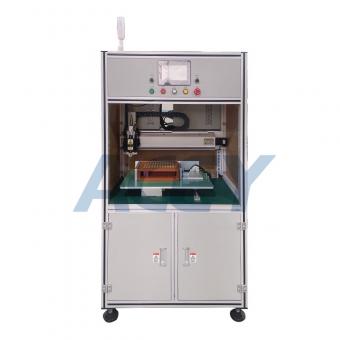 Single Side Fully Automatic Electric Spot Welder For Cylindrical Battery Pack Welding
ACEY-S200B is suitable for battery pack spot welding and assembly in the factory for 14500 / 18650 / 21700 / 26650 / 32700 multi-parallel multi-series combination.
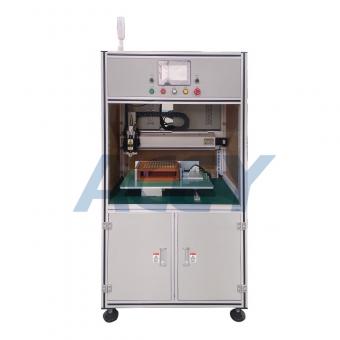 Automatic Single Side Rotary 18650 Lithium Battery Pack Spot Welding Machine
ACEY-S200C with welding head rotation function, is suitable for battery pack spot welding and assembly in the factory for 14500 / 18650 / 21700 / 26650 / 32700 multi-parallel multi-series combination.
Rm703, No.223, Qishan North Road, Huli District, Xiamen, Fujian, China
Email : allen@xmacey.com
Tel : +8618950009155
Whatsapp : +8618950009155