
XIAMEN ACEY NEW ENERGY TECHNOLOGY CO., LTD.

Categories
New Blog
How Are Battery Packs Made?
March 20 , 2026In the production of new energy batteries, battery pack assembly and testing are critical stages. They not only determine whether a battery can function normally but also directly impact its performance, safety, and service life. Below is a detailed breakdown of the specific components of battery assembly and testing.
I. Module Assembly: Building the Basic Unit of the Battery System
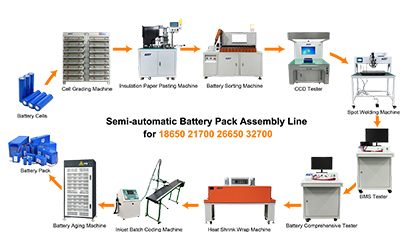
(1) Cell grading and sorting
Before module assembly, individual cells that have undergone formation and grading must be strictly screened. Based on performance indicators such as capacity, internal resistance, and voltage consistency, cells with similar performance are selected. This step is vital because excessive performance variance within the same module can lead to overcharging or over-discharging of some cells during use, while others fail to reach full potential, ultimately compromising the performance and lifespan of the entire module.
Related Product Recommendations: High-Precision Lithium Cell Sorting Machine.
(2) Series and Parallel Connection
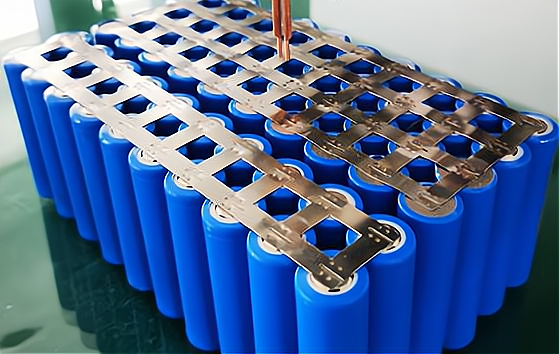
The screened cells are connected in series and parallel according to design requirements. Series connection increases the voltage of the battery module to meet the working voltage requirements of different devices; parallel connection increases the capacity to extend the device's runtime. Connections are typically made using laser welding or resistance welding processes to ensure firmness and conductivity, reducing contact resistance and energy loss.
II. Pack Assembly: Integration into a Complete Battery System
(1) Module Integration
Multiple battery modules are systematically installed into a battery enclosure for further electrical connection and mechanical fixation. During this process, it is essential to ensure reliable connections and a logical layout to fully utilize the space within the enclosure while facilitating future maintenance and inspection.
(2) Circuit Connection and System Integration
Once module installation is complete, the electrical connections for the entire Battery Pack are performed, including connecting positive and negative busbars and signal lines. This integrates the modules, BMS, and other auxiliary equipment into a complete circuit system. Additionally, the battery pack control unit is installed to manage the entire system and enable communication and interaction with external devices.
(3) Installation of Cooling Systems and Protective Structures
The Battery Pack is equipped with a more comprehensive cooling system to ensure the battery maintains a good working temperature under various operating conditions. Simultaneously, protective structures such as outer shells and insulation layers are installed to protect the battery from physical impact, dust, and moisture, enhancing the safety and reliability of the system.
III. Inspection and Testing: Guaranteeing Quality and Performance
(1) Visual Inspection
First, a visual inspection is conducted to check the battery casing for scratches, deformations, or damage. It also ensures that labels are clear and complete and all connection points are secure. Appearance defects may affect the battery's sealing, mechanical strength, and overall performance.
(2) Electrical Performance Testing
Battery pack assembly and testing is a complex and meticulous process where every step must be strictly controlled to ensure the production of high-performance, safe, and reliable battery systems. Only through high-quality assembly and rigorous testing can new energy batteries function efficiently across various fields, driving the continuous development of the industry.
703, 7F, Zhonghengji Building, No.223, Qishan North Road, Huli District, Xiamen, Fujian, China
Email : allen@xmacey.com
Tel : +8618950009155
Whatsapp : +8618950009155