How to Choose a Spot Welding Machine for Lithium Battery Pack Assembly
Spot welding is one of the main connection processes used in lithium battery pack assembly line. After the cells are arranged in the required series and parallel configuration, nickel strips or other conductive connecting materials must be welded to the cell terminals to form the electrical circuit.
For battery pack manufacturers, selecting equipment requires looking beyond just the maximum welding current; factors such as cell type, battery pack dimensions, nickel tab configuration, welding tip type, production volume requirements, the level of automation, and the equipment budget must all be comprehensively considered.
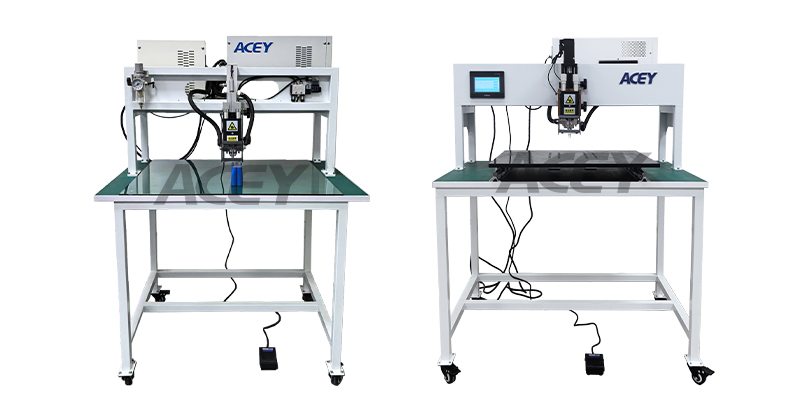
ACEY provides gantry, automatic single-sided and automatic double-sided spot welding machines. The machine structure can also be customized according to the dimensions, welding layout and production requirements of the battery pack.
What Does a Battery Pack Spot Welding Machine Do?
A battery pack spot welding machine applies controlled pressure and welding current through the electrodes to join the nickel strip to the battery terminal.
During production, the cells are first arranged and secured in a fixture. The welding head then moves to the programmed position, presses the electrodes against the nickel strip and cell terminal, and completes the weld.
Spot-welding quality is affected by several factors:
-
Welding current and pulse settings
-
Welding-head pressure
-
Electrode shape and condition
-
Nickel-strip material and thickness
-
Cell-terminal material and surface condition
-
Number, direction and spacing of weld points
-
Stability of the battery pack fixture
-
Cooling method used on automatic machines
-
Welding-program accuracy and motion positioning
For battery packs containing a large number of weld points, relying solely on manual inspection makes it difficult to verify the integrity of every joint. Features such as weld point tracking, anomaly detection, and production data logging enable operators to promptly identify issues such as spatter, cold welds, weak joints, and missed welds.
What Is the Difference Between Single-Sided and Double-Sided Welding?
Single-Sided Automatic Welding
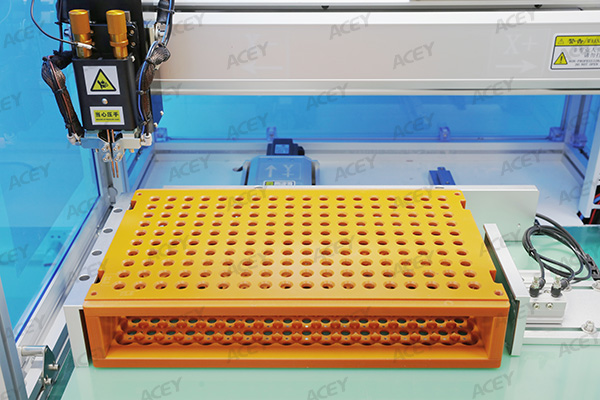
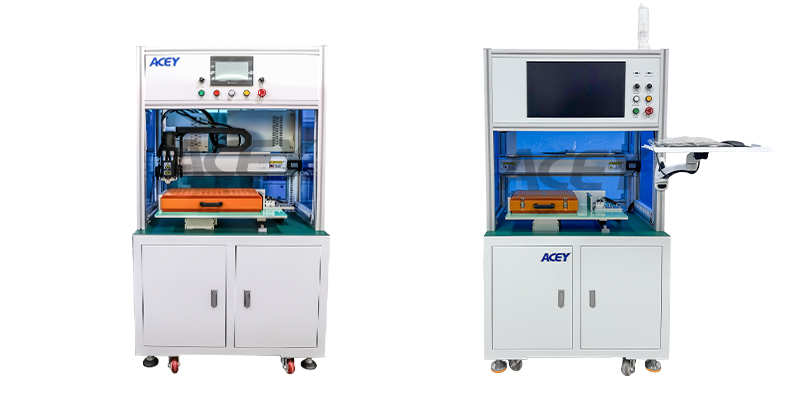
A single-sided automatic spot welder processes one side of the battery pack at a time.
After the first side has been welded, the operator turns over or repositions the battery pack and starts the program for the second side. The machine still performs automatic path movement, weld positioning, program control and welding monitoring.
This configuration is suitable for manufacturers that want to replace manual point-by-point welding but do not require a fully automated double-sided process. It also provides a practical option for small and medium production volumes or projects with a more controlled equipment budget.
Double-Sided Automatic Welding
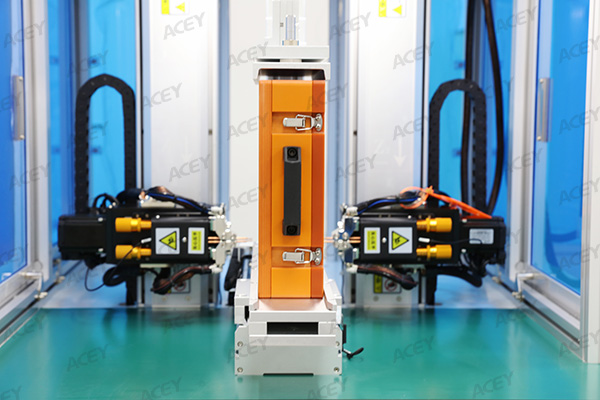
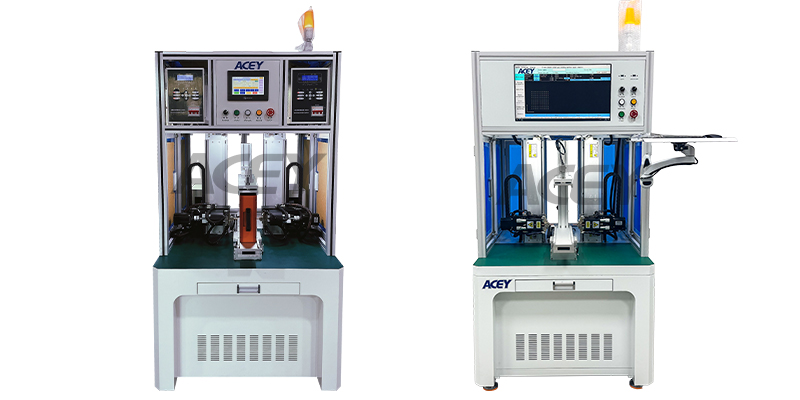
A double-sided automatic spot welder is equipped with welding mechanisms on both sides of the battery pack fixture.
It can complete the welding operations on both sides within one automated process. The operator does not need to remove and turn the battery pack after the first side is completed, which reduces manual handling and repositioning time.
A double-sided machine is better suited to repeated batch production and applications with higher requirements for efficiency and automation.
Gantry Manual Spot Welding
A gantry spot welder relies mainly on operator-controlled positioning.
The operator places the battery pack on the welding table, aligns the required welding area with the welding head, and starts the welding cycle using a foot pedal. Its open structure makes product positioning and changeover more flexible.
This machine is commonly used for sample preparation, process trials and small-batch production.
Key Factors When Selecting a Battery Pack Spot Welder
1. Battery Cell Type
The battery cell format affects fixture design, welding-head travel, electrode position and the required machine working space.
ACEY manual & automatic battery pack spot welding machine can be used for cylindrical cells such as:
-
14500
-
18650
-
21700
-
26650
-
32700
-
32140
-
33140
-
others
The cell model alone is not enough to determine the machine configuration. The complete series-parallel arrangement, terminal position, battery pack dimensions and nickel-strip layout must also be reviewed.
2. Battery Pack Dimensions
The length, width and height of the battery pack must match the effective working area of the machine.
The standard compatible range of the ACEY automatic single-sided and double-sided spot welding machines is:
|
Working Direction
|
Standard Compatible Range
|
|
X direction
|
0–500 mm
|
|
Y direction
|
0–400 mm
|
|
Z direction
|
50–140 mm
|
These values apply to the standard machine configuration. The fixture dimensions, cell height, terminal position and welding-head clearance must also be considered.
For battery packs outside the standard working range, ACEY can customize the equipment according to the actual product dimensions. For example, the machine structure can be increased in height for taller battery packs, with corresponding adjustments to the fixture position, welding-head clearance or motion travel.
Providing the complete battery pack dimensions is therefore more useful than providing only the cell model.
3. Production Volume
Production volume has a direct influence on the required level of automation.
A gantry spot welder is suitable for sample production, process verification and small batches. Since the operator controls the battery pack position, it is easier to handle products that change frequently.
A single-sided automatic spot welder is suitable for small and medium batch production. It automatically completes one side, but the battery pack must be turned over or repositioned before the other side is welded.
A double-sided automatic spot welder is better suited to repeated batch production. Reducing manual turnover and repositioning helps improve the continuity of the welding process.
The machine should be selected according to the actual hourly or daily production target rather than choosing the highest automation level by default.
4. Welding-Head Type
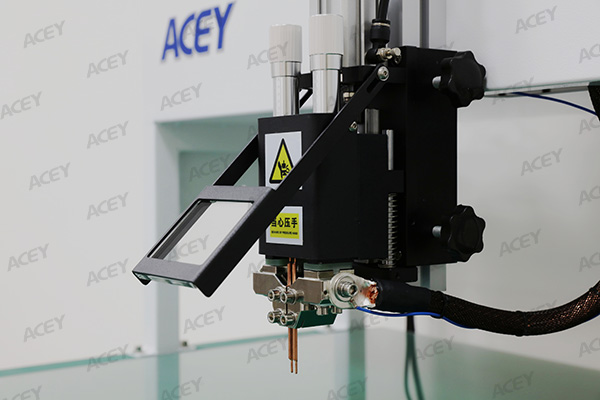
The welding-head type affects movement control, welding pressure and compatibility with different nickel-strip structures.
ACEY gantry spot welding machines are available with:
-
Pneumatic welding head
-
Stepper-driven electric welding head
-
Servo-driven electric welding head
ACEY automatic single-sided and double-sided machines are available with:
-
Pneumatic welding head
-
Stepper-driven electric welding head
-
Servo-driven electric welding head
-
Rotary welding head
The appropriate welding head should be selected according to the required pressure control, product structure, welding speed, nickel-strip shape and project budget.
*Pneumatic Welding Head
A pneumatic welding head uses compressed air to drive the welding movement and apply pressure. It has a relatively simple structure and is suitable for conventional welding applications where a stable compressed-air supply is available.
*Stepper-Driven Electric Welding Head
A stepper-driven electric welding head uses a stepper motor to control the welding-head movement. The movement can be managed through the equipment program without using a pneumatic cylinder as the welding-head drive.
*Servo-Driven Electric Welding Head
A servo-driven electric welding head uses a servo motor to control the movement. It is suitable for applications requiring greater control over welding-head motion, repeatability and operating stability.
*Rotary Welding Head
A rotary welding head is mainly used for irregular nickel strips or battery packs where the weld-point direction changes across the product.
The electrode direction of a conventional fixed welding head remains unchanged. When an irregular nickel strip contains weld points arranged at different angles, a fixed welding direction may not align correctly with every welding position.
A rotary welding head can change the electrode orientation according to the programmed welding layout, allowing the head to follow weld points at different angles.
5. Nickel-Strip Shape
Standard straight nickel strips can generally be welded using a fixed-direction welding head.
Some battery packs, however, use irregular nickel strips with bends, branches, angled sections or non-standard outlines. The weld-point orientation may change between different areas of the same battery pack.
A rotary welding head should be considered when:
-
The nickel strip has an irregular shape
-
Weld-point directions vary across the battery pack
-
Some weld points are arranged at an angle
-
Electrode orientation must follow the nickel-strip layout
-
One welding program contains several welding directions
During equipment selection, the nickel-strip drawing should be provided with the weld-point positions and directions clearly marked.
6. Welding Current and Power Supply
ACEY spot welding machines can be configured with the following welding-current options:
DC inverter welding power supplies and transistor welding power supplies are available for different welding requirements.
Maximum current alone does not determine the welding result. The final configuration must also take the following factors into account:
-
Nickel-strip material
-
Nickel-strip thickness
-
Cell-terminal material
-
Number of weld points
-
Weld-point spacing
-
Welding pressure
-
Welding pulse settings
-
Required joint strength
Excessive welding energy may cause sparks, deep electrode marks or material damage. Insufficient energy may result in weak welds or inadequate connection strength.
Sample welding with the actual cells and nickel strips is recommended before confirming the power-supply type, current level and welding parameters.
7. Air Cooling and Water Cooling
Cooling options apply mainly to the automatic single-sided and automatic double-sided machines.
ACEY automatic spot welders can be configured with:
-
Air cooling
-
Water cooling
Air cooling has a relatively simple structure and is suitable for many standard production conditions.
Water cooling provides stronger continuous heat dissipation and is more suitable for longer operating periods, higher welding frequencies or applications where heat accumulation is more noticeable.
The cooling method should be selected according to the welding current, welding frequency, welding-head structure and expected continuous operating time.
A gantry spot welding machine does not require an air-cooling or water-cooling system.
8. Programming and Product Changeover
ACEY automatic single-sided and double-sided machines support AutoCAD welding-data import.
The welding path can be prepared from the battery pack drawing, reducing the need to enter every weld-point coordinate manually. The machines also support single-point, double-point and triple-point welding modes. The distance between double or triple weld points can be set according to the nickel-strip structure.
For manufacturers producing several battery pack models, program storage and quick program recall can reduce product-changeover time.
Whether the fixture, welding head or working area must also be changed depends on the dimensional and structural differences between the battery packs.
9. Welding Monitoring
Battery packs contain a large number of connections, so abnormal welding conditions should be identified during production rather than only during final inspection.
ACEY automatic single-sided and double-sided spot welders support weld-point tracking and can monitor, record and issue alarms for conditions such as:
-
Sparks
-
False welds
-
Weak welds
-
Missed welds
-
Abnormal weld-point positions
When an abnormal condition is detected, the equipment can stop and issue an alarm, allowing the operator to inspect the electrodes, nickel strip, fixture and welding parameters.
10. Standard or Customized Equipment
Not every battery pack can be processed on a standard machine without modification.
Battery pack projects may differ in:
-
Overall length, width or height
-
Cell arrangement
-
Nickel-strip shape and weld-point direction
-
Fixture dimensions
-
Welding position depth or height
-
Production speed
-
Required automation level
ACEY can customize the machine according to the project requirements. For a battery pack that exceeds the standard height range, the equipment can be made taller. For a larger pack, the working platform, motion travel and fixture structure can also be evaluated and adjusted.
Before customization, the following information should be confirmed:
-
Battery pack length, width and height
-
Cell model
-
Series-parallel arrangement
-
Nickel-strip drawing
-
Weld-point layout
-
Product weight
-
Production-cycle requirement
-
Factory power and compressed-air conditions
CAD drawings, product photographs or physical battery pack samples help determine the required machine dimensions and customization scope more accurately.
ACEY Spot Welding Machines for Battery Pack Production
1. Automatic Single-Sided Battery Pack Spot Welding Machine
The automatic single-sided battery pack spot welding machine completes one side of the battery pack at a time.
This machine is suitable for manufacturers that require automatic weld positioning, program control and process monitoring but can accept manual pack turnover. It provides a practical balance between automation and equipment investment.
Its main functions include:
-
Automatic welding-path execution
-
AutoCAD welding-data import
-
Automatic compensation for minor electrode-position deviation
-
Production-data monitoring and recording
-
Monitoring of sparks, false welds, weak welds and missed welds
-
Single-point, double-point and triple-point welding modes
-
Adjustable weld-point spacing
-
Optional 5000A, 8000A or 10000A welding current
-
Optional DC inverter or transistor welding power supply
Available welding heads include:
-
Pneumatic welding head
-
Stepper-driven electric welding head
-
Servo-driven electric welding head
-
Rotary welding head for irregular nickel strips
Available cooling methods include:
-
Air cooling
-
Water cooling
The standard machine is compatible with cylindrical cells such as 14500, 18650, 21700, 26650 and 32700 cylindrical cells. For 32140 and 33140 cells, the equipment must be customized with increased height and width.
For battery packs outside the standard dimensions, the machine can be customized. For example, the equipment can be made taller to provide sufficient clearance for a taller pack, fixture and welding head.
This machine is suitable when:
-
Automatic weld positioning is required
-
Manual battery pack turnover is acceptable
-
Production volume is small or medium
-
Full automation is not essential
-
Initial equipment investment needs to be controlled
-
Several welding programs need to be stored and reused
2. Automatic Double-Sided Battery Pack Spot Welding Machine
The automatic double-sided battery pack spot welding machine is equipped with welding mechanisms on both sides of the battery pack.
It completes the welding operations on the positive and negative sides within one automated process. Compared with a single-sided machine, it reduces the need for manual battery pack turnover and repositioning.
Its main functions include:
-
Automated double-sided welding process
-
AutoCAD welding-data import
-
Automatic compensation for electrode-position deviation
-
Weld-point tracking
-
Production-data recording
-
Abnormal-weld monitoring and alarms
-
Single-point, double-point and triple-point welding
-
Adjustable weld-point spacing
-
Optional 5000A, 8000A or 10000A welding current
-
Optional DC inverter or transistor welding power supply
Available welding heads include:
-
Pneumatic welding head
-
Stepper-driven electric welding head
-
Servo-driven electric welding head
-
Rotary welding head for irregular nickel strips
Available cooling methods include:
-
Air cooling
-
Water cooling
The standard equipment can process cylindrical cells such as 14500, 18650, 21700, 26650 and 32700 cylindrical cells. For 32140 and 33140 cells, the equipment must be customized with increased height and width.
The equipment can also be customized for battery packs with different dimensions and structures. For example, the machine can be increased in height for taller battery packs. The platform, motion travel and fixture can also be evaluated for larger products.
This machine is more suitable when:
-
Battery packs are produced in repeated batches
-
Manual turnover needs to be reduced
-
Higher production efficiency is required
-
Product structure is relatively stable
-
A higher level of automation is required
-
Positioning consistency between the two welding stages is important
3. Gantry Battery Pack Spot Welding Machine
The gantry manual battery pack spot welder is suitable for product trials, sample preparation and small-batch production.
The operator places the battery pack on the welding table, aligns the weld point with the welding head, and starts the welding cycle using a foot pedal. The open gantry structure makes it easier to adjust the battery pack position and accommodate changing product dimensions or welding layouts.
Available welding heads include:
-
Pneumatic welding head
-
Stepper-driven electric welding head
-
Servo-driven electric welding head
The machine can be equipped with a DC inverter or transistor welding power supply, with selectable welding currents of 5000A, 8000A or 10000A.
The gantry machine does not require an additional air-cooling or water-cooling system.
It can also be customized according to the battery pack dimensions. For example, the gantry structure can be increased in height for taller battery packs, providing sufficient space for the product, fixture and welding head. Other structural changes can be evaluated according to the battery pack drawing.
This machine is suitable when:
-
Battery pack designs change frequently
-
Production is focused on samples or small batches
-
Operators need direct access to the welding area
-
Different battery formats or dimensions must be processed
-
Manual positioning is acceptable
-
A complete automatic motion program is unnecessary
-
Initial equipment investment needs to remain controlled
Compared with automatic machines, the gantry machine depends more on the operator for production efficiency and weld-position consistency. Its main advantages are flexibility, easier changeover and a lower level of equipment investment.
Comparison of the Three Machine Types
|
Machine Type
|
Welding Process
|
Welding-Head Options
|
Cooling Configuration
|
Customization
|
Recommended Application
|
|
Automatic single-sided spot welder
|
Welds one side first, then the pack is turned or repositioned for the second side
|
Pneumatic, stepper electric, servo electric or rotary
|
Air or water cooling
|
Machine height, working range and fixture can be adjusted
|
Small and medium batches with moderate automation requirements
|
|
Automatic double-sided spot welder
|
Completes both sides within one automated production process
|
Pneumatic, stepper electric, servo electric or rotary
|
Air or water cooling
|
Machine height, working range and fixture can be adjusted
|
Batch production with higher efficiency and automation requirements
|
|
Gantry spot welder
|
Operator positions the battery pack and starts welding with a foot pedal
|
Pneumatic, stepper electric or servo electric
|
No cooling equipment required
|
Gantry height and structure can be adjusted for different pack dimensions
|
Samples, process development and small-batch production
|
Why Welding Current Alone Cannot Determine Weld Quality
Welding current is important, but it should not be used as the only basis for machine selection or weld-quality evaluation.
Even when two battery packs use the same cell model, they may require different welding parameters because of differences in nickel-strip thickness, terminal structure or weld-point layout.
The final welding result is influenced by:
-
Nickel-strip material and thickness
-
Cell-terminal material
-
Electrode-tip shape
-
Welding pressure
-
Welding time and pulse settings
-
Number and spacing of weld points
-
Surface condition
-
Cooling condition on automatic machines
-
Fixture stability
Excessive welding energy may cause sparks, deep electrode marks or damage to the connecting material. Insufficient energy may result in false welds, weak welds or inadequate joint strength.
The final machine configuration should be confirmed by reviewing the battery pack drawing, material specifications and sample-welding results.
How to Maintain Stable Battery Pack Spot Welding
*Keep the Electrodes Clean
Electrode tips gradually wear and collect material during production. Changes in the electrode shape or contact area can affect welding pressure and current distribution.
The electrodes should be inspected, cleaned or replaced according to actual production conditions.
*Use a Stable Fixture
The fixture must hold the cells and nickel strips in the correct positions. Movement during welding may cause weld-point deviation, poor contact or inconsistent pressure.
A customized fixture should be designed for battery packs with non-standard dimensions or structures.
*Check the Nickel-Strip Position
Before welding, the nickel strip should lie flat against the cell terminal. Bending, misalignment or gaps between the strip and terminal may lead to unstable welding.
For irregular nickel strips, a rotary welding head can be considered on an automatic single-sided or double-sided machine.
*Select the Appropriate Cooling Method for Automatic Machines
During continuous production, heat accumulation at the welding head and electrodes should be considered.
Water cooling may be selected for higher welding frequencies or longer continuous operating periods. Air cooling is suitable for many standard production conditions.
A gantry spot welder does not require cooling equipment.
*Review Welding Alarms
When the machine reports sparks, false welds, weak welds or missed welds, the cause should be checked before production continues.
Possible causes include:
-
Electrode wear
-
Incorrect welding pressure
-
Nickel-strip movement
-
Unsuitable welding parameters
-
Fixture deviation
-
Poor contact with the battery terminal
-
Verify Weld Strength
Visual appearance alone cannot fully confirm weld strength. Weld samples should be tested according to the quality requirements of the battery pack.
Information Required Before Configuring a Spot Welder
To determine the machine structure, welding-head type, cooling method and customization scope, the following information should be provided:
|
Required Information
|
Details
|
|
Battery format
|
Cylindrical battery
|
|
Cell model
|
Such as 14500, 18650, 21700, 26650, 32650, 32700, 32140 or 33140
|
|
Battery pack structure
|
Series and parallel arrangement
|
|
Battery pack dimensions
|
Length, width and height
|
|
Battery pack weight
|
Used to evaluate the platform and fixture
|
|
Nickel-strip information
|
Material, thickness and shape
|
|
Weld-point layout
|
Number, position, direction and spacing
|
|
Production target
|
Required output per hour or per day
|
|
Automation requirement
|
Gantry, automatic single-sided or automatic double-sided
|
|
Welding-head requirement
|
Pneumatic, stepper electric, servo electric or rotary
|
|
Cooling requirement
|
Air or water cooling for automatic machines; none for the gantry machine
|
|
Customization requirement
|
Increased height, larger working area or customized fixture
|
|
Factory utilities
|
Power supply and compressed-air availability
|
|
Data requirement
|
Production recording or equipment communication
|
|
Reference materials
|
CAD drawings, product photographs or battery pack samples
|
For irregular nickel strips, the drawing should clearly show the strip shape and weld-point directions. For battery packs outside the standard dimensions, the complete length, width and height should be provided so that the need for a taller machine or a larger working space can be evaluated.
Conclusion
Both the positive and negative sides of a lithium battery pack normally require welding. The difference between single-sided and double-sided spot welding machines lies in how the two welding stages are completed and the level of automation involved.
An automatic single-sided machine welds one side first. The operator then turns or repositions the battery pack before the other side is welded. It is suitable for manufacturers that require automatic welding but have moderate automation requirements or a more controlled equipment budget.
An automatic double-sided machine integrates the welding of both sides into one automated process. It reduces manual turnover and repositioning and is better suited to repeated batch production with higher efficiency requirements.
A gantry spot welder uses operator-controlled positioning and foot-pedal activation. It is suitable for samples, product trials and small-batch production. Pneumatic, stepper-driven electric and servo-driven electric welding heads are available, and no additional cooling system is required.
Automatic single-sided and double-sided machines can use pneumatic, stepper-driven electric, servo-driven electric or rotary welding heads. Rotary welding heads are mainly used for irregular nickel strips and products with changing weld-point directions. Air cooling and water cooling are available according to the production conditions.
ACEY can also customize the equipment according to different battery pack dimensions, structures and welding requirements. For example, the machine can be made taller to accommodate a higher battery pack and provide sufficient clearance for the product, fixture and welding head.
Providing complete battery pack dimensions, CAD drawings, nickel-strip drawings or physical samples helps determine the appropriate machine type, welding-head configuration, cooling method and customization plan.
FAQ
1. What is a gantry battery pack spot welder used for?
A gantry spot welder is commonly used for sample preparation, product development, process trials and small-batch production.
The operator positions the battery pack on the welding table and starts the welding cycle using a foot pedal. Its open structure provides flexibility for battery packs with changing dimensions, structures or welding positions.
2. Does the gantry spot welding machine require cooling equipment?
No. The ACEY gantry battery pack spot welding machine does not require additional air-cooling or water-cooling equipment.
3. What welding heads are available for the gantry spot welder?
The gantry battery pack spot welder can be equipped with:
-
Pneumatic welding head
-
Stepper-driven electric welding head
-
Servo-driven electric welding head
The appropriate option depends on the welding process, pressure-control requirements, product structure and project budget.
4. What welding heads are available for automatic spot welders?
Automatic single-sided and double-sided spot welding machines can be equipped with:
-
Pneumatic welding head
-
Stepper-driven electric welding head
-
Servo-driven electric welding head
-
Rotary welding head
The rotary welding head is mainly used for irregular nickel strips or products with changing weld-point directions.
5. What is a rotary welding head used for?
A rotary welding head adjusts the electrode orientation according to the programmed welding layout.
It is suitable for irregular nickel strips, angled weld points and battery pack designs where the weld-point direction changes between different areas of the product.
6. What battery cell sizes can the automatic machines process?
The standard automatic single-sided and double-sided spot welding machines can be configured for cylindrical cells such as:
-
14500
-
18650
-
21700
-
26650
-
32700
For larger cylindrical cells such as 32140 and 33140, the machine needs to be customized with increased height and width to provide sufficient space for the battery pack, fixture and welding-head movement.
7. Can the spot welding machine be customized for different battery pack sizes?
Yes. ACEY can customize the machine according to the battery pack dimensions, structure and welding requirements.
For example, the equipment can be made taller for a higher battery pack. The working platform, motion travel, fixture and welding-head clearance can also be adjusted for larger or non-standard products.
8. What welding-current options are available?
ACEY battery pack spot welding machines can be configured with 5000A, 8000A or 10000A welding current. DC inverter and transistor welding power supplies are also available.