
XIAMEN ACEY NEW ENERGY TECHNOLOGY CO., LTD.

Categories
New Blog
The Influence Of Copper Foil Thickness On Lithium Battery Performance
June 24 , 2025
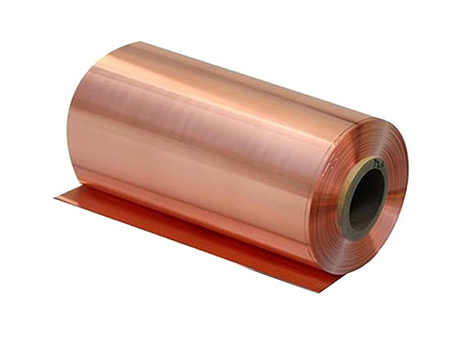
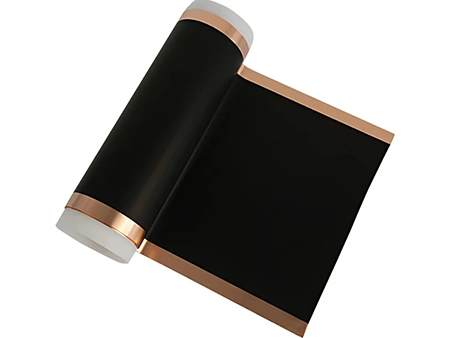
Copper foil is used as the negative electrode carrier and current collector of lithium-ion batteries. The thickness of copper foil plays a vital role in lithium batteries, and it will affect the performance, safety and cost of lithium batteries.
1.1 Mass energy density
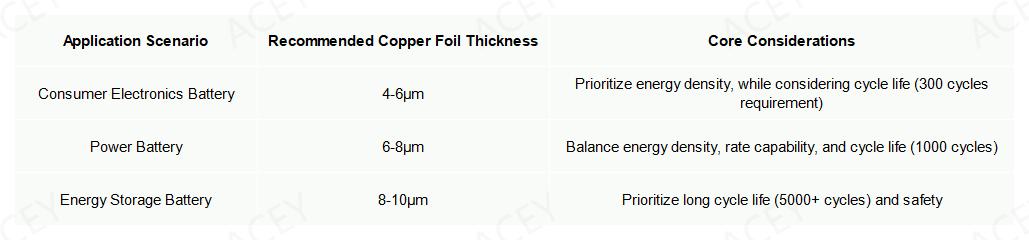
Copper foil, as a battery current collector, does not participate in the electrochemical reaction itself. The thinner its thickness, the higher the proportion of active materials (such as graphite) in the battery. For example, reducing the thickness of copper foil from 10μm to 6μm will reduce the overall mass of inactive materials in the battery by about 40%, and more active materials can be accommodated at the same volume. Theoretically, the mass energy density can be increased by 5%-8%.
1.2 Volume energy density
The thickness advantage of thin copper foil directly reduces the volume proportion of inactive materials inside the battery. Taking 18650 batteries as an example, using 8μm copper foil compared to 12μm copper foil can increase the internal space utilization of the battery by about 3%, and the volume energy density is correspondingly increased.
Thin copper foil has lower resistance, and the current distribution is more uniform during large current charging and discharging, avoiding local overheating. For example, a battery with 6μm copper foil can maintain a discharge capacity retention rate of 85% at a 10C rate, while a battery with 10μm copper foil is only 78%. Especially in high-power power batteries, thin copper foil has a more significant improvement in rate performance.
3.2 Risk of lithium dendrite penetration
If lithium dendrites grow on the negative electrode of copper foil with a thickness of less than 5μm during long-term cycling, it is easier to be penetrated by dendrites, resulting in internal short circuits. Studies have shown that the internal short circuit failure rate of batteries using copper foils below 5μm in the later stages of the cycle is about 30% higher than that of batteries with 8μm copper foil.
4.2 Performance of needle puncture test
Thick copper foil (such as 10μm) can delay the occurrence of internal short circuit in the needle puncture test because the copper foil itself has a certain mechanical barrier effect. Test data shows that the peak temperature of thermal runaway of the battery with 10μm copper foil is 210℃ when needle punctured, while the peak temperature of the battery with 6μm copper foil reaches 240℃, and the risk of thermal runaway is higher.The thickness of copper foil is linearly related to cost: the unit price of 8μm copper foil is about 120 yuan/kg, and the unit price of 4μm copper foil can reach more than 200 yuan/kg due to the complex production process. Taking 1GWh power battery as an example, the material cost of using 6μm copper foil is about 800,000 yuan higher than that of 10μm copper foil.
Thin copper foil (<5μm) is prone to uneven thickness during rolling, requiring the roller accuracy to reach ±0.5μm, and the equipment investment is 50% higher than that of conventional production lines.
5.2.2 Coating process:When thin copper foil carries active substances, the coating tension control requirements are more stringent. Tension fluctuations exceeding 5N will cause the pole piece to wrinkle, and the yield rate will drop from 95% to below 85%.
Rm703, No.223, Qishan North Road, Huli District, Xiamen, Fujian, China
Email : allen@xmacey.com
Tel : +8618950009155
Whatsapp : +8618950009155