
XIAMEN ACEY NEW ENERGY TECHNOLOGY CO., LTD.

Categories
New Blog
What Are The Differences Between Lithium Batteries With Different Discharge Rates?
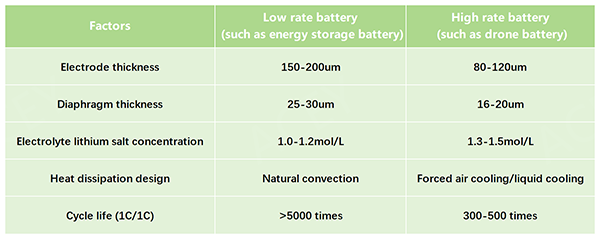
April 25 , 2025Electrode thickness and porosity: Thin electrodes (such as <100μm) can shorten the lithium ion diffusion path and support high rates; high porosity (such as 40%-50%) enhances electrolyte wetting and reduces polarization.
Diaphragm pore size and wettability: Small pore size (such as <10nm) can suppress dendrites, but may increase ion transmission resistance; ceramic-coated diaphragms can improve heat resistance and support high-rate discharge.

Packaging pressure: Insufficient packaging pressure of soft-pack batteries may cause electrode dislocation and increase contact resistance.
Operating temperature: At low temperatures (such as -20℃), the electrolyte ion conductivity drops by 3-4 orders of magnitude, resulting in a sharp drop in the available discharge rate.
SOC estimation accuracy: The internal resistance increases significantly at low SOC, and the BMS may dynamically adjust the allowable discharge rate to avoid voltage drop.

16s 100A 48V BMS For Lifepo4 Battery
Active material shedding: High-rate cycling may accelerate electrode pulverization and reduce the effective reaction area.
Acey New Energy is a high-tech enterprise. Our R&D team specializes in researching and manufacturing high-end equipment for lithium-ion batteries. Our business covers semi-automatic & fully automatic assembly machines for cylindrical, prismatic, and pouch battery packs; battery cell & pack testing systems; lab-scale fabrication machines for coin cells, cylindrical cells, and pouch cells; battery environmental safety testing equipment; battery materials; and supercapacitor production equipment, etc.
703, 7F, Zhonghengji Building, No.223, Qishan North Road, Huli District, Xiamen, Fujian, China
Email : allen@xmacey.com
Tel : +8618950009155
Whatsapp : +8618950009155