Language : English

English

 Automatic Battery Pack Assembly Line For ESS

What Is the Difference Between Battery and ESS?

April 24 , 2026
Voltage Levels and Pack Hierarchy in Residential Energy Storage Systems: A Logical Breakdown from Cell to System


In the development and operation of residential energy storage products, the voltage hierarchy and Pack structure are often confused core concepts. This article takes a high-voltage residential battery module as an example and breaks down the full-chain hierarchy—from cell, module, battery pack to system—to clarify the logic behind voltage formation and define the boundaries of “Pack.” It provides a reusable technical framework for industry practitioners.


Battery System Hierarchy: From Cell to Complete System

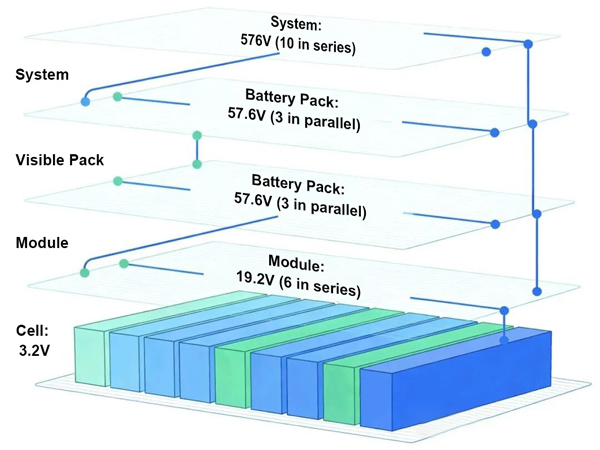
The construction of a residential battery system follows a bottom-up stacking logic, from micro to macro levels. Each layer corresponds to distinct voltage and functional definitions, which is the key to understanding voltage differences:

  • Cell
The most basic electrochemical unit and the smallest carrier of energy. In residential applications, prismatic lithium iron phosphate (LFP) cells are commonly used, with typical parameters of 3.2V nominal voltage and 314Ah capacity. Each cell delivers approximately 1kWh of energy and serves as the foundation for all higher-level structures.


  • Module / Small Pack
Multiple cells are combined in series and/or parallel to form an intermediate unit with independent voltage output. Series connection increases voltage, while parallel connection increases capacity. Modules are the core building blocks of battery packs and key nodes for voltage monitoring.


  • Battery Pack
Based on modules, additional components such as enclosure, BMS (Battery Management System), sampling boards, wiring harnesses, and thermal management are integrated to form a complete unit capable of independent power output. The battery pack is the primary delivery form of residential storage products, with standardized energy and voltage specifications.


  • Battery System
Multiple battery packs are connected in series and/or parallel and integrated with an inverter/PCS (Power Conversion System) to form a complete grid-connected energy storage system. The system-level voltage is determined by the pack configuration and DC/DC boost modules.

While the voltage hierarchy—from cell to module, battery pack, and system—defines the electrical architecture of residential ESS, it also directly determines how the battery must be manufactured.

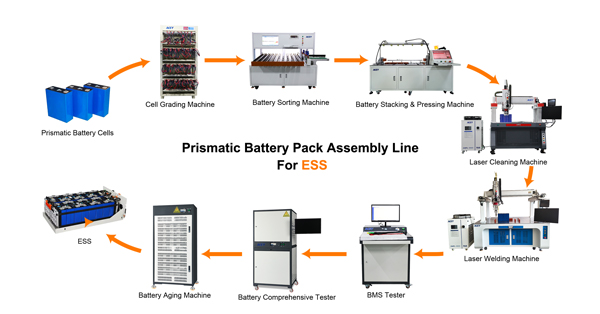
To support different production scales and product designs, we provide both semi-automatic and fully automatic ESS battery assembly solutions, covering the complete process from cell testing to pack integration.

For flexible production scenarios such as pilot lines or multi-model manufacturing, semi-automatic battery assembly lines offer a cost-effective solution. The solution include cell sorting and matching, module stacking, busbar welding, BMS installation, and functional testing. They are ideal for manufacturers seeking adaptability while maintaining process control.


For large-scale and standardized production, fully automatic ESS battery assembly lines enable high efficiency and consistency. These systems integrate automated cell feeding, robotic module assembly, laser welding, inline BMS installation, and end-of-line testing, often combined with MES systems for full data traceability. Such solutions are particularly suitable for high-voltage battery pack manufacturing and mass production environments.

By aligning battery design (voltage structure) with production capability (assembly process), manufacturers can ensure better consistency, safety, and scalability in residential energy storage systems.

Voltage Hierarchy Breakdown: From Tens of Volts to 720V

Taking an 8.04kWh high-voltage residential battery module as an example, voltage differences at each level arise from cell configuration and circuit design:

1. Cell-Level Voltage: 3.2V
A single LFP cell has a nominal voltage of 3.2V (3.65V fully charged, 2.5V discharged). This is determined by electrochemical properties and cannot directly power a residential system. Series/parallel combinations are required to increase voltage and energy.

2. Module-Level Voltage: 25.6V
To achieve 8.04kWh, the battery uses a module design with 8 cells in series:

*Voltage: 3.2V × 8 = 25.6V
*Capacity: remains 314Ah (unchanged in series)
*Energy: 25.6V × 314Ah ÷ 1000 ≈ 8.04kWh
This “20+ volts” value often seen in monitoring systems corresponds to module-level voltage, not system voltage.


3. Battery Pack Voltage: 25.6V (Base) / ~400V (After DC/DC Boost)
Base output: 25.6V directly from the module, monitored by the BMS
DC/DC boost: The pack integrates a DC/DC module to step up voltage to ~400V, preparing for high-voltage system integration


4. System-Level Voltage: 720V
Two identical 8.04kWh battery packs are connected in series:

Single pack (after boost): ~400V
System voltage: 400V × 2 ≈ 800V

The rated voltage is labeled as 720V, corresponding to an actual operating range of approximately 720V–950V. This is the final voltage supplied to the inverter and the key parameter on the product nameplate.

Pack Definition Boundaries: Module vs. Battery Pack vs. System

The term “Pack” is often used ambiguously. Its meaning depends on context:

1. Small Pack / Module
A group of cells connected in series/parallel, without a full enclosure or complete BMS. It is an internal component of a battery pack. Example: a 51.2V module formed by 16 cells in series.


2. Large Pack / Battery Pack
A fully integrated unit with enclosure, BMS, interfaces, and protection functions. It is the smallest deliverable unit in residential storage products. The 8.04kWh unit discussed here is a typical large Pack.


3. System-Level Pack
Multiple battery packs connected together and working with an inverter/PCS to form a complete system. In this case, two packs connected in series to form a 720V system represent a system-level Pack.

Common Misconceptions and Key Technical Points


  • Confusing Voltage and Energy
Energy (kWh) = Voltage (V) × Capacity (Ah) ÷ 1000, “20+ volts” refers to module-level voltage, while 720V refers to system-level voltage. They belong to different layers and cannot be directly compared.


  • Differences in Cell Form Factors
Cylindrical cells (e.g., 18650, 21700) often seen are still at the Cell level, just like prismatic cells used in residential systems. The difference lies in form factor and application.


  • Role of Series Connection
Series connection is the primary method to increase voltage. Voltage increases from cell → module → pack → system are all achieved through series connections. Parallel connection only increases capacity.


  • Value of DC/DC Modules
High-voltage residential systems rely on DC/DC modules to boost low-voltage packs into high-voltage ranges, enabling multi-pack series configurations and meeting grid connection requirements. This is a key feature of high-voltage systems.

Conclusion

The voltage hierarchy and Pack structure of residential energy storage systems can be summarized as follows:
  • Voltage is determined by hierarchy: progressing from the individual cell (3.2V) to the module (25.6V), the battery pack (~400V), and finally the system (720V), voltage levels accumulate as the hierarchical level increases.
  • Pack definitions are clearly delineated: a "Small Pack" refers to an internal module; a "Large Pack" constitutes an independently deliverable unit; and a "System-level Pack" represents the complete system formed by the combination of multiple packs.
  • The underlying technical logic is unified: series connections are utilized to boost voltage, parallel connections to expand capacity, and DC/DC modules to facilitate the conversion from low to high voltage—forming the universal design philosophy for high-voltage residential energy storage products.

Acey New Energy specializes in providing complete production equipment and one-stop solutions for lithium ion battery pack assembly line—from cell to pack—tailored to newcomers in the lithium battery energy storage field. Whether it's production line planning, equipment integration, or key stages such as module stacking, laser welding, BMS integration, and final pack testing, we deliver reliable technical support and efficient, stable production systems. We sincerely welcome customers from all over the world and hope to be your professional and reliable partner to create a better future together.


Leave a message
Leave a message
If you are interested in our products and want to know more details,please leave a message here,we will reply you as soon as we can.

Home

Products

contact

whatsApp